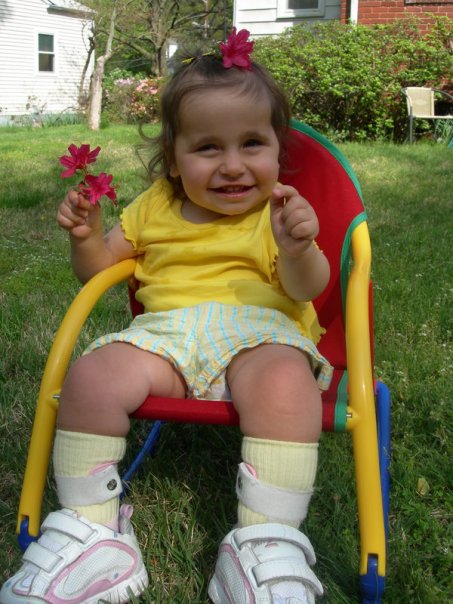
Little kids, and sometimes adults too, used to come up to me and ask me “What’s wrong with her?” when I was out and about with Sarah. I don’t blame kids for having questions but there was never any good answer and I sucked at handling this situation. Sarah understood everything that was said around her and she hated it too. She did not like having her disability discussed with strangers. Well, who would?
There was never any easy way to explain what was “wrong” with Sarah and it took many years and a lot of missteps to find out. Pregnancy and birth were perfectly normal and I passed all the prenatal tests, including amnioscentesis and genetic screenings. I remember Max and I casually saying when I was pregnant that if there were a problem, we would terminate. I was so ignorant and unknowing then.
Sarah was born full-term and other than being a little on the small side (5 lbs, 14 oz), she was a typical infant. I remember my brother reassured me she would be ten pounds in no time, and she took to nursing like a champ, plumping up beautifully. We ended up nursing together for 19 months. Doctors and physical therapists always seem amazed that she had no problems nursing considering all her other issues, but perhaps her high arched palate, which is a symptom of her condition, helped in that area.
Early on she was perfectly normal, even a bit advanced in her acquisition of vocabulary. She said DaDa at six months and added some words steadily after that. She smiled, laughed, was very social, and loved Peekaboo. Around this time I was involved with an online mothers’ group who all had babies born the same month. We moms had “stickies” we put on our posts when our babies achieved milestones such as “I can roll over!” and “I can sit independently!” and even “I can crawl!” I began to notice that a lot of the babies had all these stickies. Sarah had stickies for her first word and her social smile, but she didn’t have any stickies for physical development. She wasn’t even playing with her feet or even really noticing their existence.
I talked to our pediatrician at the six month visit and she advised watchful waiting. A lot of kids were meeting milestones later because of the sleep-on-your-back movement. She didn’t feel Sarah had any signs of delay. Perhaps I was extra watchful because my nephew, my brother’s youngest son, had been through Early Intervention due to hypotonia. He hadn’t been walking at 20 months, but a referral to Early Intervention got him walking and he was fine by age 3. I also didn’t walk until 19 months, and my father was apparently a late walker too. I felt if there were a family history of hypotonia we should be proactive. So when Sarah hadn’t rolled over or sat up by nine months, we contacted Early Intervention in our county. We assumed, and her working diagnosis at that point, was hypotonia.
Sarah had a great time with the therapists at Early Intervention who worked hard with her until her third birthday, but she never really made progress. She did learn how to roll over with a great deal of effort, sort of like watching a turtle right itself when it lands on its shell, but she didn’t crawl, walk, stand, or sit independently. At that age, she could still use her hands and arms pretty much normally. She was also having some regression issues with her speech in terms of not using words she had used in the past and we started private speech therapy.
During this period we took Sarah to a neurologist at Children’s Hospital and she had a number of tests, including a brain MRI, which did not clearly show much of anything. But over the next months there was a fight among the neurologists and radiologists interpreting the MRI about very subtle signs of white matter syndrome, basal ganglia undersignaling, hypoxia, and other such fun terms. I remember one neuroradiologist called me and told me Sarah definitely had White Matter Syndrome. I googled all about it, joined a support group, bought a t-shirt supporting a foundation, and was settling nicely into my role as a White Matter Syndrome mom when our lead neurologist came back from vacation, called us, and said that Sarah definitely did not have White Matter Syndrome, there were absolutely zero signs of that on Sarah’s MRI. For the love of God.
I should mention that we did a lot of genetic testing, but this was around 2007 or 2008, and genetic testing was pretty raw. They suspected a possible mitochondrial disorder, but couldn’t find one in the testing results. It was explained to us that mitochondrial disorders were often very hard to detect. At around this time (Sarah Age 2), a good friend of ours recommended that we go to Kennedy-Krieger Institute in Baltimore and see the wonderful Alec Hoon, the head of the Movement Disorders Clinic there (now retired). Dr. Hoon became our mentor and the head of Sarah’s team.
Dr. Hoon told us that Sarah had cerebral palsy, which is not a diagnosis but is a description of the condition of her muscles and overall physical and neurological functioning. It felt like a relief to us to know this and have someone say it flat out. He said we needed to discover the cause of her condition. It used to be that people thought that CP was caused by lack of oxygen at birth, but now they know that it’s usually caused by a variety of genetic factors. So he included on our team a great neurogeneticist, Dr. Ali Fatemi.
Dr. Fatemi also felt strongly that Sarah had a genetic mitochondrial disorder, and he started trying to track it down. But the gene testing technology had to catch up with us, and it didn’t until 2013, when whole exome testing became available. Sarah, Max, and I sent a little vial of our spit in to a private company and about a year later we got a report that said Sarah had a condition called Hereditary Spastic Paraplegia, Type SPG-4. An illness that usually impacts people in their 40’s and 50’s. And not only that, for her, it wasn’t hereditary, it was a mutation in a gene. And it wasn’t spastic, it was dystonic. And it wasn’t paraplegia, it was quadriplegia.
Yes, we were befuddled and aggravated. This is the answer? An illness that doesn’t fit her condition? A gene that causes middle-aged people to walk funny? How does this explain anything? We even took Sarah out to Michigan, to the “guru” of SPG-4, to see if there was anything about her condition which was tell-tale or need-to-know. His opinion was that she had cerebral palsy, and the SPG-4 diagnosis was just a coincidental overlay.
So we pretty much forgot about or didn’t think about the SPG-4 diagnosis for several years. We concentrated on therapies and we explained to Sarah that she had cerebral palsy. Meanwhile, Sarah was losing skills, which is not a hallmark of cerebral palsy. Cerebral palsy is not a progressive illness.
One day when Sarah was about 11, I was out at her therapeutic horseback riding group, chatting with another mother. We wondered why the group teacher gave the girls “report cards” for their horsebackriding progress the way typical kids get. “These kids are not going to progress with skills,” we agreed. The other mother then became upset and starting telling me she didn’t understand something about her daughter, a girl Sarah’s age. “She has never met a single goal in physical therapy,” she told me. “Not one.” She was clearly baffled. “I just don’t understand it.” What diagnosis does your daughter have, I asked her? “SPG-7.”
I had never met another child before with SPG and it was like a light went off in my head. This is progressive. This isn’t cerebral palsy. But I had no validation until 2020, when we were contacted by our genetic counselor. She told us that research now showed there are two subtypes of SPG-4, an uncomplicated type, which is the kind that manifests in middle age with trouble walking, and a complex infantile type that starts in early childhood, that is progressive and involves the entire body, plus intellectual disability and some distinctive features. Now you tell us, I thought.
 The First Year Without Sarah