We are definitely fully committed to the HBO show Gomorrah now. One of the things I find fascinating is that the head of the crime family, Don Pietro, is currently in prison and he’s in a communal cell that has maybe 10 men, with bunks for them, and a very large dining table. There’s a bathroom of course en suite, and there’s also a kitchen, stocked with pots, pans, an array of produce, and so forth, and every day the men in this cell cook together and eat these incredible-looking meals around their large table. (Their female visitors also bring them a lot of food.)
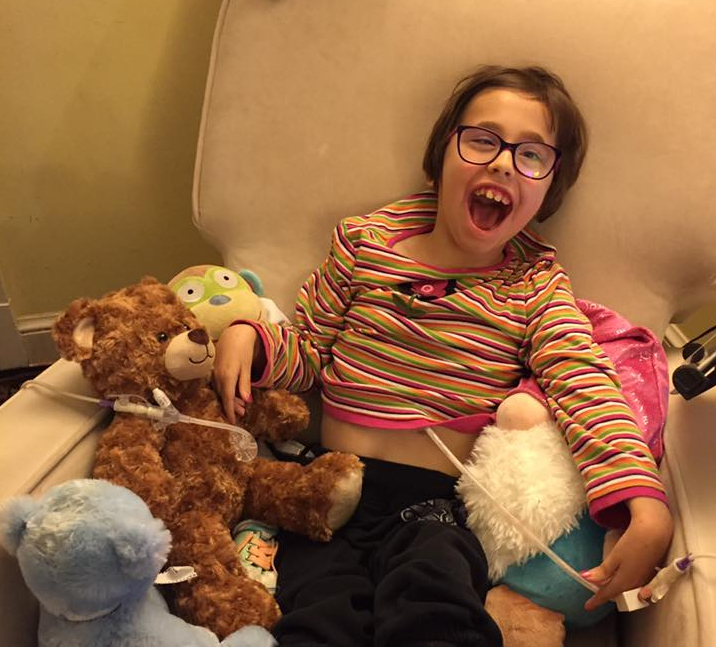
Frankly, these Neopolitan prison meals are of far better quality than anything I have ever cooked up or possibly eaten. Dinner time has always been a bit of a sore subject in our house. We’ve never officially had a family dinner with the three of us around the dining room table and food and drink and conversation and so forth. Sarah needed to be fed by hand for many years, and this was an intensive, time-consuming task that often resulted in tears, begging, and showdowns between her and Max, her official feeder. Her overall muscle weakness affected her facial and jaw muscles and her tongue and it took a lot of energy for her to chew and swallow. Because she had dystonia (a movement disorder), she burned a lot of calories just from muscle movement, and Max tried to stuff as much food into her as possible. But she was always very, very, small and thin. At age 5, she looked like a toddler; at age 10, she looked like a 4 year old and weighed 39 pounds and was around 40 inches tall.
Several times along the way medical professionals suggested a feeding tube to make things easier for us. Looking back, we resisted for far too long. It was psychologically difficult for us to concede that we couldn’t feed our child. Food was like love, food was warmth and sustenance.
Finally, the summer we went to Camp Chatterbox, the AAC camp, we were helped to change our minds by living with so many other families of kids with severe disabilities. Also, the food was terrible there and it was dreadfully difficult to get Sarah to eat. We heard from so many of the other families “What are you waiting for?” and that life was so much easier for their children once they went the way of tube feeding. That when a child was within striking distance of puberty, it was just impossible to keep up with growth spurts through manual feeding.
So after camp and discussing it with the crew at Johns Hopkins and Kennedy Krieger, we talked to Sarah and read books about kids with feeding tubes and explained there could be an operation to put a button in her tummy through which she would eat and take medicine instead of chewing her food. She was enthusiastic right away and wanted one.
After she got the feeding tube, she gained 11 pounds and grew over 3 inches in the first few months. It felt like a miracle. So Sarah was not exactly a foodie by the time of her death. Like many kids with feeding tubes, she mostly lost all interest in eating by mouth and rarely did so. She weighed 70 pounds and was 52 inches tall when she died, though her height was very hard to measure so that’s just an estimate. My little pixie.
 The First Year Without Sarah