Sarah lost a lot of little skills very incrementally, and we would sometimes look at photos of her and say things like “Remember when she could hold a book in her hand?” “Remember when she sat up straight when she was doing therapeutic horsebackriding?” There was no particular moment she would lose the skill. It just seemed to flow away. One explanation we got, which I think I’ve mentioned before, was that kids with cerebral palsy have to relearn physical skills as they grow and adjust to their bigger bodies, and teach themselves the skill all over again, and it becomes harder and harder.
This explanation never made too much sense to me. Sarah was tiny. She weighed 39 pounds at Age 10 and she was the size of a four year-old. The notion that she was teetering around like a runway model teaching herself how to walk in 8-inch heels, or like one of those weird challenges in America’s Next Top Model where the girls have to walk on a runway made of jello or something, just didn’t jive with me. She gained weight and height very, very slowly. A pound and an inch a year was huge for her. We were so used to being below the bottom of the growth charts that our pediatrician didn’t bother showing us our percentages.
I don’t think we every really sat with and reckoned with the phenomenon. It was more like, oh, Sarah hasn’t taken any steps at ballet since January. Oh well, Sarah doesn’t use her pincer grasp anymore. Sarah doesn’t really use new words anymore, have you heard her say anything? And no real reason, so the only result of dwelling on it was anxiety and panic.
I drove by Sarah’s preschool yesterday. I was on my way to the mall to get a haircut, and I saw the turnoff for it, and just decided to go on a whim. School ended for the year this week so I didn’t think I’d be disturbing the kids.
The facade of the school and the main parking lot looked just the same. I remember every spring there was a fair in the parking lot with little games and prizes and a cake walk. We would always go. There was a barbecue going on for staff and teachers in the back parking lot and I skedaddled quickly.
Sarah’s preschool was in a school for medically fragile children and it had a nurse, doctor, and a pool that the preschool kids could use as well as great physical therapy facilities. Some of the kids in her class stayed there through high school, and other kids, like Sarah, left and went to other programs. We had the reassurance that she could always come back if she needed to.
During the three years she was there, a letter used to come home from the Principal’s Office about once a month or so concerning the death of a child, usually a child in the high school or middle school grades, from their medical condition. The principal would write and explain that the child had passed away, and say “It is always so hard to understand the death of a child.” And offer other words of solace and provide information about the funeral and any support for the family that was needed.
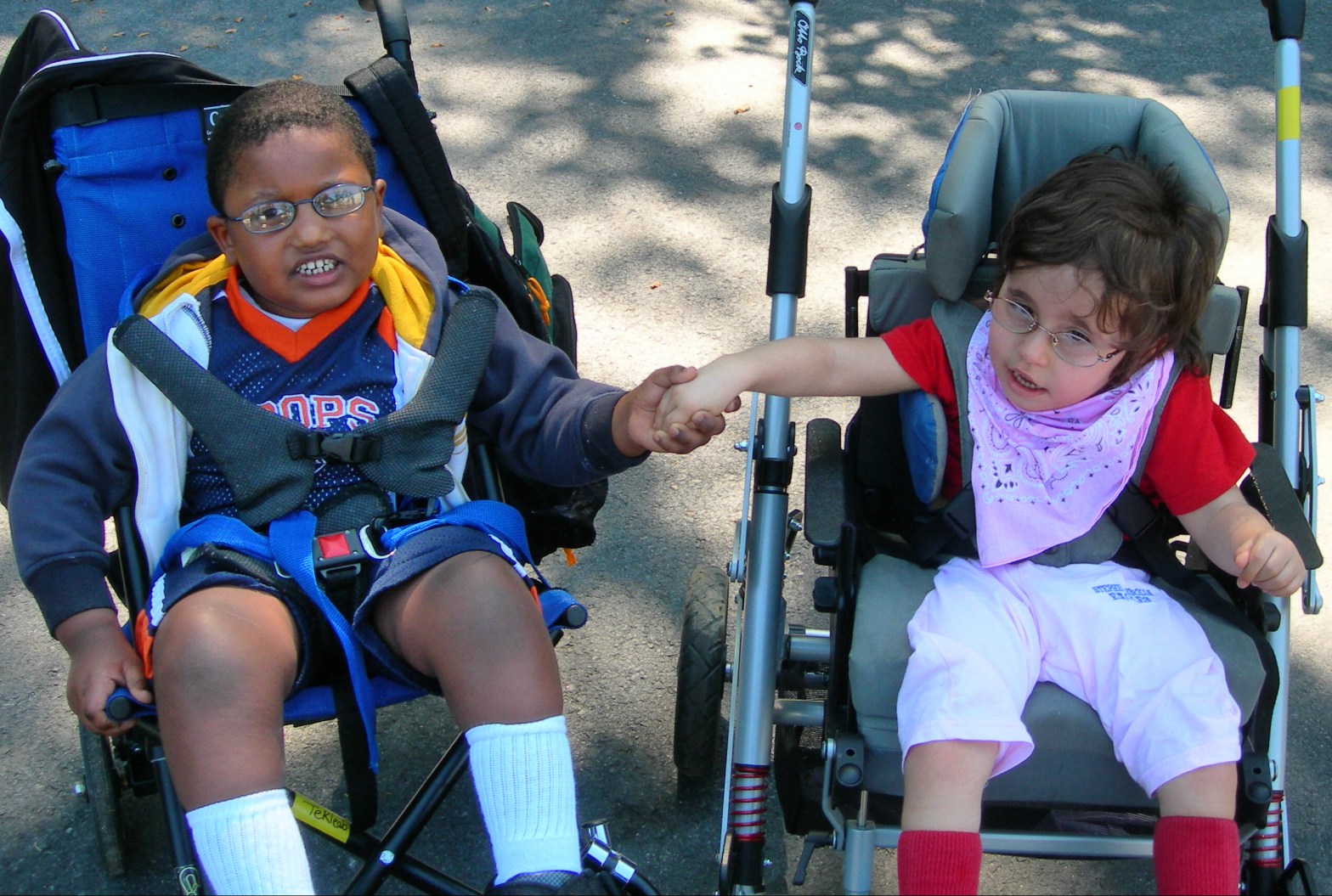
I never imagined Sarah being a dead child when she was at Stephen Knolls. She seemed like a little superstar. Her teachers talked about how bright and able she was, her wonderful smile, how she was going to enter the Augmentative Communication program for kindergarten, all the things she would do, how many friends she had. She had a little friend there, an Ethiopian boy named Tekleab (pronounced Teklay) and she and Teklay liked to hold hands on outings from their wheelchair strollers and were very close. She had birthday parties and outings to the Pumpkin Patch and so forth.
As I was pulling away, I kept hearing the text of the principal, Mrs. Shrewsbury’s, letter in my mind, “It is always so hard to understand the death of a child.” I can’t understand it. Sarah was here, at this school, totally alive. She can’t be gone. The world can’t still be turning.
 The First Year Without Sarah