-
Mindset

Yesterday was kind of a shit show. When I got up from my midday nap, Max told me that the leader of our Grief Group had called, wanting to know about my “mindset” about continuing with the group. I was a little baffled. There was an awkward scene at the last meeting, which was the first in-person meeting of the group we had ever been to. I’m pretty sure I wrote about it. Some other members had been small-talking about their 16 year-old daughters and how difficult they were, and it just got to me and I got upset, thinking about Sarah. Max and I ended up leaving for that evening, but it was with the blessing of the leader, and we didn’t storm out; we left at her suggestion. We said good night to people and said it wasn’t “our night” and we were getting over Covid and so forth. I haven’t thought that much about it since then, quite honestly.
We called back the Grief Group leader and she told us that since the next session of the group was coming up soon, she needed a decision from me. A decision about what? “You need to decide if this is really the group for you,” she told me. “Are you asking us to leave the group?” I inquired point-blank. “Because it sounds like you are asking me to leave the group, and I had no intention or desire to leave the group.” After some hemming and hawing, she said that most members except us had lost their children a decade or more ago and were not dealing with acute feelings of grief, and this probably wasn’t the right group for us. Wow. Okay.
So basically, we (or me because it’s my fault) got kicked out of Grief Group because we had actual strong triggering feelings of grief that we expressed. Rather than simply sharing the stories of our kids’ deaths in 2011 or 1998, and discussing our grief more intellectually. I’m exasperated and befuddled, and also embarrassed. Why do I keep getting thrown out of groups? Could it be me? I asked Max, laughing. “You have a strong resistance to accepting support, honey” he told me. Which is true.
I think I mentioned that my Dad brought a folder of papers and old letters down to give to me when he visited. There’s an old letter he wrote to me when I was applying to law schools back in the day, with his views on some of the top law schools. University of Chicago – very conservative and vested in economic theory. Dad’s not sure I would be too happy there. New York University – good public interest scholarship available that I should think about applying for. All seemed to me now to be sensible and sensitive takes on these schools. But apparently when I received the letter I did not like getting his views and I sent it back to him with a haughty dismissal.
I don’t think what the Grief Group leader did was terribly professional, but if she prefers to run a Grief Group that’s not dealing with anyone’s acute feelings of grief, I guess that’s her prerogative. My friend Susan told me a story a while ago about joining a grief group after her husband died. One night she couldn’t find a sitter for her young twins and she brought them to the group and told the leader the twins were just going to color or read quietly in the hallway outside the group. The grief group leader not only refused to let the kids stay (kids that had just lost their father) but told Susan she would call Security if they all didn’t leave immediately. Maybe people who run grief groups have a high level of burnout, hearing death stories constantly. It could be a very difficult profession.
Max’s bottom line is that we have to find another grief group to go to, or maybe even a personal grief counselor for the two of us. He thinks it’s very important. And I agree. We have to continue working our way through this. Hopefully we can find a group of upset, depressed, grouchy, peevish, support-hating introverts with dead children that we can bond with and be griefy with.
-
Managing Partner
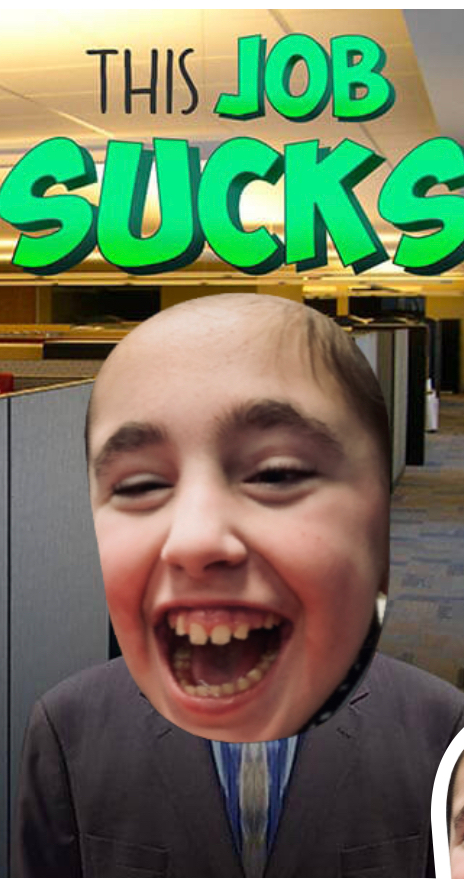
Back when I first graduated from law school I worked for a DC law firm for a couple of years. It was not a positive experience. I had spent a summer working for the firm in another city and received an offer, and then I asked to come to DC to work. My request was granted. I wasn’t exactly enthusiastic about law firm life but I had a large student loan debt to pay off.
I wasn’t really receiving quality assignments at the firm, although I tried. I couldn’t really seem to make things gel for myself or find a niche. Almost a year into my experience, a more senior associate who I had become friends with told me that shortly after I had first arrived, the Managing Partner had said of me “If that new female associate doesn’t pick her head up off the carpet and say “Good morning” to me when I see her in the hallway, I’m going to fire her.” Apparently his negative vibe toward me had filtered through the partnership.
I had no idea I had made such a bad impression. I had operated under the assumption that important people should be left alone with their percolating thought bubbles, especially in the early mornings, and not interrupted by mundane morning-person good cheer. I had apparently really goofed with that philosophy. On top of that, bad eyesight and a lack of depth perception often leads me to look down when I am walking. I’m a stumbler. I was frozen with remorse over my terrible life choices.
I eventually left that firm and went to another firm that specialized in labor law, and I got some substantive experience, but I pretty quickly figured out I’m just not a law firm person, and I decided I could make my budget stretch in a federal government job. I’ve never been sorry I made that decision.
No matter how prepared you are, no matter how hard you try, you will never be able to control every variable. You can be dressed for success and ready and able to work hard and then some pompous ass gets mad that you haven’t greeted him properly. It’s impossible to consider all the dependent and independent variables all the time, much less to be able to factor for whether death is going to claim your family members.
I tried to control every aspect of Sarah’s life, to make sure she was always protected, safe, having fun, healthy, treated well and fairly, educated to the best extent possible, seeing friends, and receiving the best therapies out there. There was always more I felt I could be doing. Sometimes I think we may have even overmanaged her a little bit. When she was 13 or 14 and had become moodier and less inclined to want to do things in the community, Max and I decided that it would be wise to rule out depression and we visited the Neuropsychiatric Clinic at Kennedy-Krieger with Sarah. The psychologist thought Sarah was adjusting to Middle School and being an adolescent who had less interest in going places with her parents. I just didn’t want us to stumble and I didn’t want Sarah to fall on our watch. But I couldn’t control it all.
-
Stress Eating
There was a very triggering post this morning on my local moms discussion board about weight, overweight, and what to do to “control” an overweight daughter. It seems the mom in question visited her daughter at college and saw that she had gained a lot of weight. The mom was “repulsed” (her words). The daughter was having a difficult transition to an intense campus and was taking an SSRI and seeing a school therapist for depression and binge eating.
It sounded like a pretty mundane story to me, like the transition story of many first year students at college, who often gain weight as a matter of course, and yet the mother was writing “Help me!” and asking if she should “tell the therapist” to take the adult daughter off the SSRI, or force her daughter into playing a sport.
It made me both sad and angry. My first years at college and law school were difficult and unsettling. Food has often been the mechanism by which I seek comfort or stuff down my feelings. I don’t drink alcohol because I take medication to control seizures – which works – but like many people with epilepsy I’m prone to depression. It’s just part of the package of the disorder that adds a little more fun to the mix. I’ve lost and gained weight so many times in my life and felt better or worse about my own worth as a result.
When I moved to start law school, I left behind a guy I thought I’d been in love with. We’d talked about marriage but he was a Peter Pan type and I subsequently broke up with him that fall in light of the distance I now had from him, and the excruciatingly competitive new friends I was making at law school, all of whom wanted to be Supreme Court Clerks or Editor-in-Chief of the Law Review, or save the world in some fashion.
I was very sad about the break-up all the same, and that fall there was a bad cold spell that brought temperatures down to about zero for a couple of weeks. It was really really cold in my old apartment, and I was eating sweets, and studying, and outlining, and getting ready for my first exams, and when they were over, my classmates hit the bars. I did not. I ate. And then, on a whim, I bought myself a bottle of Syrup of Ipecac to make myself throw up. It was the beginning of a very bad cycle in my life that was to last for almost eight years.
I can’t believe looking back now how much energy I put into having bulimia. It’s a very time-consuming disorder. I remember one horrible fight with a close friend I had who I promised to meet at High Holidays Services, but then I stood him up because in my mind I had eaten too much and needed to make myself throw up. He was irate and baffled about my no-show and who could blame him?
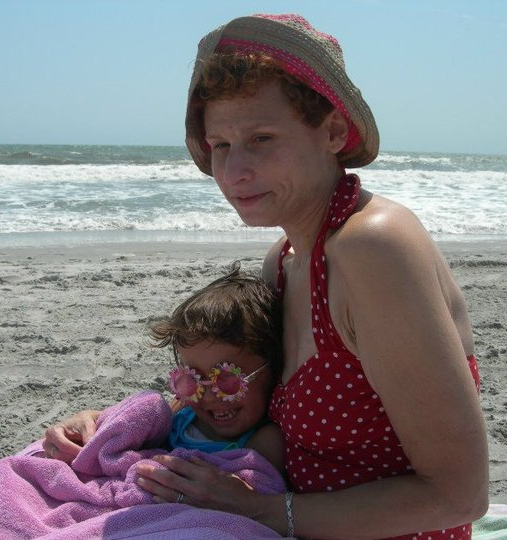
Eventually, with the aid of a very good therapist, and an SSRI, I stopped making myself throw up. It was right after my first nephew was born. It had been tapering off gradually, and then Matthew arrived. Initially, I think I was feeling a little jealous and maybe displaced because the entire family was discussing Matthew non-stop (he’s the first grandchild on both sides) and his perfection, his beautiful face, his perfect mouth. What about my mouth when I was a baby, I’d think? Then I thought to myself, really, I’m not four years old. He’s not competition for love, he’s someone new to love. He’s a new chance, a shiny penny. And I decided to make his birth the reason I stopped purging completely. So I did.
What does any of this have to do with Sarah? She was going to be a shiny penny too, and in so many ways she was. I loved her little female body in a way I’ve never been able to love my own. She was so perfect and beautiful.
-
Life Span

I realized this morning that we are right on the cusp of my first Mother’s Day since Sarah died. Part of me thinks it will be a sad day but part of me is Zen about it. We never participated in the Mother’s Day Brunch industrial complex due to our family’s eating habits and Sarah’s wheelchair. Max would usually get me flowers and Sarah would make me a collage or card with the help of her tutor Emily. My mom always sent me a card too, which I thought was sweet, telling me what a good mother she thought I was. I sent her a card too of course.
My mother’s mother, my Grandma Gertie, lived to be 106 (we think). She never was open about her exact age but some historical details she let slip led us to calculate that as her probable age. When I was a kid growing up and I asked her how old she was, she would tell me she was 16. She died a couple of years after Sarah was born. My other grandparents died when I was in my teens.
I always expected that my mother would likely be a centenarian too like Grandma Gertie, but things did not turn out that way. You can’t make predictions about peoples’ life spans. My dad of course is still active and “in full possession” of himself at 90, despite having had rheumatic fever as a boy and some heart issues from that. I hope he lives at least another 10 years.
The same website that reminded me that Mother’s Day is upcoming told me that the hardest way of mothering is to be the mother of a dead child, or something like that. That is pretty depressing. It is difficult not knowing where Sarah is now and whether she’s happy, well cared-for, and what she does with her time. I realize that makes her sound like a dog who has been rehomed, and I know that she is dead, and not doing anything with her time. That reminds me of the old joke, “What would Elvis Presley be doing if he were alive today? Scratching on the lid of his coffin.”
When I started my writing I was at the stage where I wondered if I was even a mother anymore now that Sarah is gone, so I guess I am making progress with grief or resolving some of these internal issues. That’s a good thing, but also a scary thing. Every step away from Sarah is scary. What if I live to be 106? Will she just be a blip in my life? Will the 16 years, 5 months, and 28 days of her life stop mattering to me?
-
Just in Case
Max and I are watching a new show, “Godfather of Harlem.” We like it a lot, and I especially like the song that plays at the beginning over the credits sequence, Just in Case by Swiss Beatz, Rick Ross, and DMX. The chorus makes me cry a bit sometimes. It goes:
Open up my window again (yeah)
Open up my window again (yeah)
I can hear death calling my name (it’s calling)
I can hear death calling my name (it’s calling)At the end of the chorus the singer says “Just in case…” and Max likes to joke “Well, I guess his name must be Justin Case” which always steals a laugh out of me and makes me not so maudlin.
I feel like death has been chasing me or I’ve been chasing death for quite a while now. Not that I’m suicidal, which I’m not, but with the deaths of Sarah and my mother. And the knowledge and fear that children with severe disabilities sometimes die suddenly and die young. Max would try to reassure me, telling me that Sarah was going to live a long, long life, and that I didn’t need to be so anxious, but it seemed like I was always in some state of hypervigilance.
Ebay notified me the other day about a sale it thought I might be interested in. This this time last year I ordered a couple of old high school yearbooks from the site. I went to Ninth Grade in Austin, Texas, where my father was teaching at the University of Texas, and then we moved back to Washington, D.C., where I finished high school. I had been thinking about old classmates in Austin, and Googling some. I had a sort of “frenemy,” let’s call her Lisa, who was often not very nice to me. My websurfing found an obituary that revealed she had died in her early twenties from a genetically-inherited medical condition. I don’t think she knew she had the disorder when I was in school with her but I remember that she was very petite and underdeveloped in Ninth Grade, which is apparently one of the possible hallmarks of this genetic disorder, just as it was for my daughter’s disorder. She also had some learning disabilities, again like Sarah.
I ended up ordering a couple of Austin High yearbooks because I wanted to see what Lisa looked like as a junior and senior in high school, whether she had ever really blossomed into adolescence, and what had become of her. I guess there was something I wanted to learn from this experience of a girl with a genetic disorder dying young and going through high school. I got the yearbooks and they showed that Lisa had been very pretty, petite but feminine and womanly (this is starting to sound weird), and she seemed to be involved in all sorts of school activities during her years at Austin High.
I pretty much forgot about my brief obsession with my former classmate until Ebay asked if I wanted another set of yearbooks, and it took me a minute to figure out why the site was asking. Then the moments spent looking up Lisa’s diagnosis and flipping through yearbooks came back to me, and I saw the yearbooks on the bookshelf in my study. I checked Ebay to see when I ordered them, and the site just says “more than a year ago.” It must have been last spring or winter when Sarah was in her first year of high school.
I have a compulsion to prepare myself, to make lists, to be super-organized and on time and ahead of the game and never late and check off my goals. But I just couldn’t prepare myself for Sarah’s death. It’s just not possible. And that’s so hard.
-
Hearts
My dad has returned to NYC for now, but will be moving to the area to an independent living facility about 20 minutes from here sometime late this summer. I’m pleased that he will be close by and that he made this decision. But it’s hard not to feel guilty about the prospect of a new, different post-Sarah life. A new era.
When Dad was here he ended up sleeping on the couch, but we did offer him Sarah’s room originally as a guest room. This was a kind of big step for Max and me, but it made sense for him to be on the first floor and have her large bathroom for himself. I moved all Sarah’s stuffies off her bed, apologizing to them, and made it up for Dad with a grown-up set of sheets and a real quilt. Max pointed out that the Sleep Safe bed isn’t really as long as a regular bed and Dad might not be comfortable in it. It’s also fairly high. Sure enough, Dad wasn’t up for it and preferred the couch.
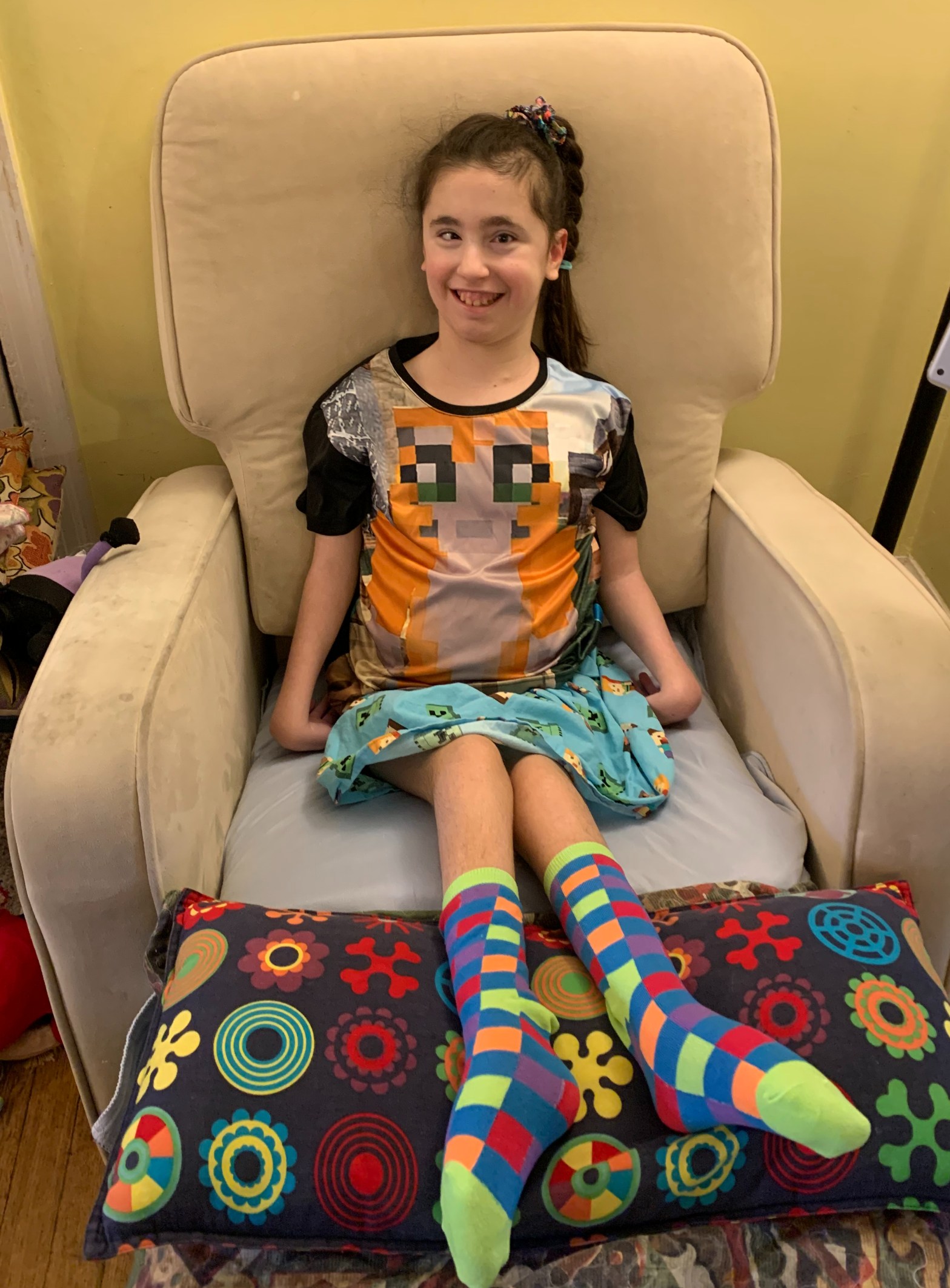
Last night after Dad left I was remaking Sarah’s bed with her preferred Stampy and Minecraft sheets and pillowcases and then putting back and arranging and re-arranging all her bed stuffies (as opposed to her living room stuffies and her stuffie cubby stuffies) and it got me rather tearful. I managed to remember all of their names after a little bit of self-prompting, which frankly isn’t easy.
Dad and Max and I went out to dinner several times, and we also played cutthroat games of Hearts and Oh Hell! which Dad, even at 90, always seemed to win. We talked a lot and reminisced about my Mom and our family. There was mention of Sarah but it was not a Sarah-centric weekend. I slept well and I did not wake up at 3 or 4 in the morning. Dad and I of course visited the new place he will be moving to, and after he made a decision, we talked a lot about decorating his new apartment, which will be fun once he concedes to all the paint colors and posts I’ve marked on Houzz. (Joking).
I’ve been pushing myself to find a new meaning and center to my life, or at least something to help fill up the time I’m not working other than watching TV, but when Dad was down here and I was distracted and having fun, I seemed to end up feeling guilty. I keep telling myself it’s okay for me to enjoy time with my father, that it’s not a betrayal of Sarah. She loved Papa Vic. And I don’t have to be a housebound, TV documentary-watching, getting up at 4 o’clock in the morning person in order to adequately honor her memory. I felt like she was with me when I tried to shoot the moon at Hearts. I didn’t make it, but she was definitely there, my Queen of Hearts.
-
Legacies

I talk a lot about my family of origin, which is half of Sarah, but I’ve hardly touched on Max’s family background at all. Max’s parents were really a whole generation older than my parents. His dad Leonard was born in 1918, and Max’s grandfather died from the Spanish Flu before Max’s dad was born. Max’s mom Jeannette was born, I think, in or around 1923. They got married right around the start of World War II and had their first son, Max’s oldest brother Jeffrey, when she was 18 or 19. Max’s dad was in WW II but was posted to serve as a guard for prisoners-of-war in Texas rather than being sent to the front. Max’s mom was a real Rosie the Riveter, working in factories in Philadelphia during the war and raising Jeff, and Max’s other brothers Ted, Kit, and Bruce. These four brothers are (I think) 21, 18, 14, and 12 years older than Max respectively. (I may have to publish a retraction.)
Max made his surprise appearance late in his parents’ lives when his mom was well into her forties and his dad was fiftyish. Jeff was right on the cusp of leaving for graduate school in Michigan and Ted had plans to go to medical school. Max and I were both surprise babies in our families and have that in common, but were both very loved and welcomed.
Max was born in early July and his mom really didn’t skip a beat from her usual summer routine of packing up the family and going to the Jersey Shore from Philadelphia for the summer. She took baby Max from the hospital and he’s gone every summer since then, more or less. Sarah loved the Jersey Shore so much too and had that legacy from infancy.
Max’s dad died long before our relationship started, and unfortunately, his mom died when I was pregnant with Sarah. We gave Sarah her name, Jeannette, as a middle name, and we also gave Sarah his mom’s Jewish name, Shaindel, as her Jewish name. Max’s dad didn’t start out Jewish, but he converted to Judaism in the very political 1930’s. He was one of those 1930’s radical student types who believed fiercely that Communism was going to save the world, and was trying to organize labor unions and fight oppression along with his mostly Jewish friends. So he converted to Judaism, although like my family, Max’s family was never particularly observant or devout. Unfortunately, Leonard would come to regret his radical leanings (but not his conversion) by the late 1940s and early 1950s, when the McCarthy hearings opened and Leonard was holding down a U.S. government job – a job he loved – as a a field investigator for the Philadelphia Office of the National Labor Relations Board. He quit rather than take the chance that the hearings could expose his past and threaten his family, and went to work as a certified public accountant, a job he didn’t like and was never happy with.
I’ve had a long career in government myself, and many years ago, when Max’s mother was alive, she urged me to apply for a promotion opportunity that I was considering at the National Labor Relations Board, where Leonard had worked. “You will like the intellectual atmosphere there,” she told me. I took the job, and it felt like my closing the loop somehow. I kept a picture of Leonard on the job in the 1940’s on the wall of my office. I even had fantasies of Sarah possibly working for the Board some day in some capacity. A family legacy.
-
Graduate School

My Dad has been visiting us this weekend to look at a potential independent living situation near here. (I was calling his relocating ‘going to college’ a few posts ago but that seemed a bit twee and I’m over that). He seems pretty serious about the potential move but not yet dealing with the logistics of it all.
He brought with him a large folio of old letters and documents for me with my name on it. Apparently he’s been sorting through his stuff for some time now, since my Mom died. I had no idea that Dad saved virtually every card and letter I sent him, throughout childhood and adolescence and onward, as well as report cards, the invitation to my Bat Mitzvah (a hideous chartreuse color that I picked out myself) and many other mementos from me or about me. He said he gave a similar file to my brother.
I really had no idea my father took such an interest in me. I mean, that sounds absurd, he’s a loving concerned Dad of course, but I think I perceived my parents as people who got married very young (24 and 26,) in keeping with the times, and were concentrating on their own development, both professional and personal. My Dad went to graduate school in Urban Planning when I was a kid and wrote his Ph.D. dissertation and became an expert in that area, and my mom, who had been a reading teacher, went to Social Work school. They were busy people.
But when I think about it, Max wrote his doctoral dissertation in Literature when Sarah was a baby and toddler and received his Ph.D. He worked a lot at night when she and I were sleeping, and on the weekends too. I would take her out so there would be less disturbance. I remember one Easter Sunday when she was about 14 months old he was in his study writing, and I was driving around with her trying to find someplace open to amuse her and keep her out of the house. I think we ended up at Target.
Max got his doctorate from Rutgers in 2008 when Sarah was 2, and I don’t think she was deprived in any way by his attending to this project. Probably the relief and satisfaction of the accomplishment helped him focus more on us. She certainly was a happy baby.
After I became a parent, I think I began to forgive my parents for a lot of past “mistakes” and a lot of hurts I carried from childhood and adolescence. I began to realize that most of parenting was shoot-from-the-hip, make your best guess and go for it, and not some calculated scenario that had been thought out in advance and executed to the parents’ lasting satisfaction and my psychological detriment. My parents were usually trying to do their best, and when they screwed up, they were often exhausted, overwhelmed, or just driving around trying to find an open Target, like me.
-
Trailhead
The park where I often walk Polly the Beagle (and where Sarah’s planned memorial bench will go) has a very large open area of playing fields and swing sets and a nice big path that takes you all the way around the park through pines and other trees. There’s also a more wooded area of the park with a couple of trails where dogs often get walked around and teens hang out. When she was younger, Polly loved to pull us down these wooded trails and zoom off when she saw rabbits or squirrels. She was never exactly a well-trained dog and we spent a lot of time calling her name in this area of the park.
The last few years Polly hasn’t been interested in going down the wooded trails. She hasn’t explored them at all since she was about eight years old. She still takes us to the park pretty often but she walks around the open area and makes a loop by the enclosed garden area. Friday, she went over to the trailhead and sniffed a little bit, and I thought maybe she was going to go down there. I was surprised. I even asked her if she wanted to go down the trail with me. But she turned away and led us back into the main part of the park. She clearly felt that wasn’t part of her life anymore, and that was that.
Her life has changed. That’s it. The Polly who went down the trail is not her any longer. No need to sit at the top of the trailhead and mourn the old Polly for her. As opposed to me, who can’t get through the park or go anywhere really without crying and thinking about my old life, my new life, the meaning of my life, and how to build something new.
Last night I dreamed of Sarah, that I had woken her up for school and dressed her, but then she wanted to get more sleep. This would never have happened in real life, but in my dream she just wanted a few more minutes to snooze. I put her in bed in her clothes, and then when I heard the bus coming, I grabbed her out of bed and in the dream I was holding her in my arms and spinning or gently twirling with her to wake her up. She was still half asleep but she was enjoying it. I was saying “Lovely, lovely, lovely” over and over in the dream as I held her and twirled her. I guess this is a way of wishing she would come back to life somehow. It felt so good in the dream to have her in my arms again.
-
Cookies and Cream

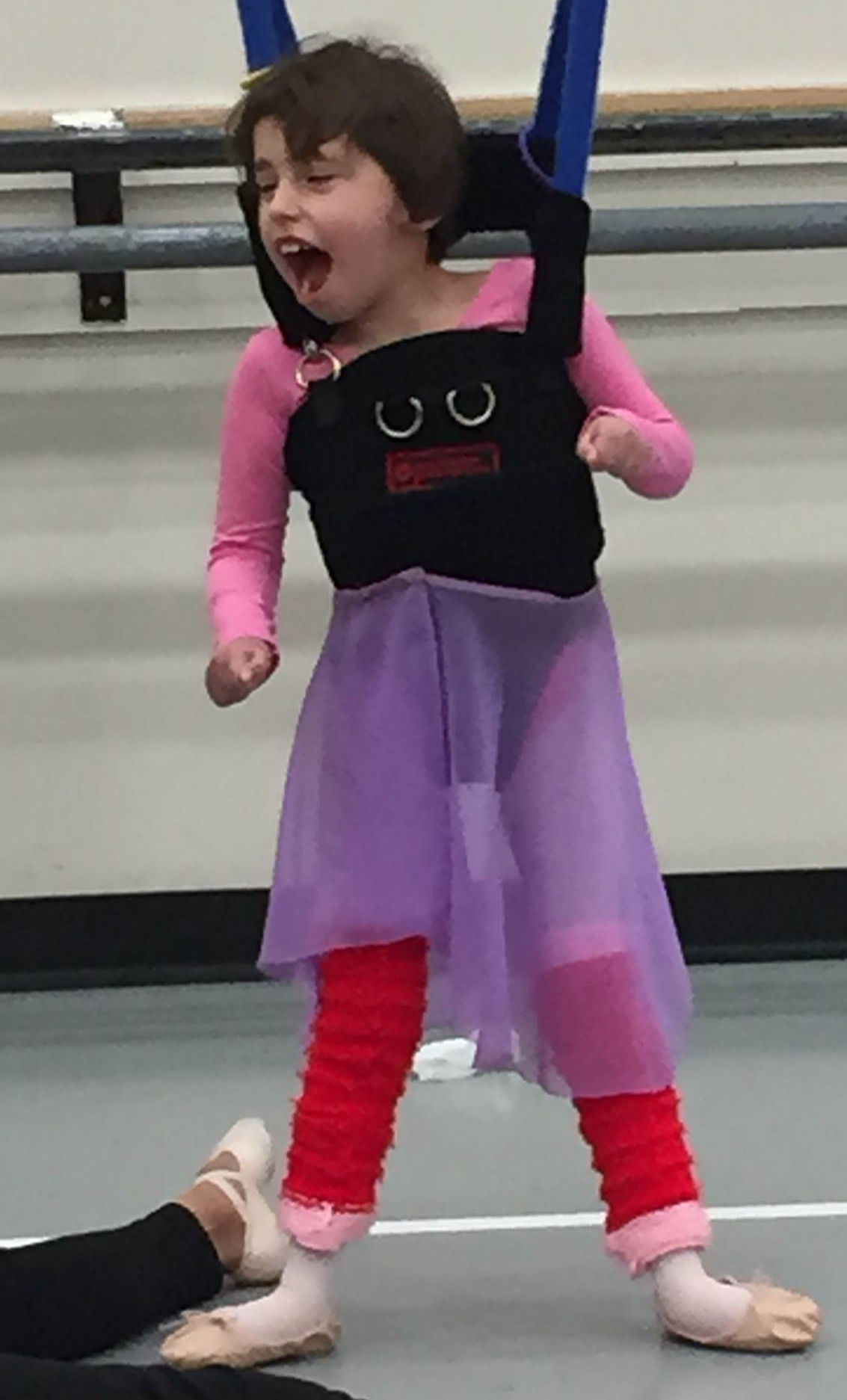
Starting from when she was very little Sarah was given injections of Botox to help with her condition every three to six months. It wasn’t a cosmetic procedure. Botox apparently works by freezing certain very localized muscle groups where it’s administered and then it somehow helps to “unfreeze” the muscle groups next to them. It’s very helpful for people with movement disorders like dystonia and cerebral palsy. Sarah would get injections into her calf and hamstring muscles to assist with her ability to stretch and move those muscles and walk with supportive harnesses in ballet and physical therapy. It wears off after a few months.
For the first couple of years, when we were hooked up with the local children’s hospital, their routine was to do the Botox procedure like a day surgery. Sarah would be admitted as an inpatient for the day and we would have to meet with an anesthesiologist and a staff neurologist performing the procedure. All kids would receive full anesthesia through an IV on the grounds that Botox shots were painful, and the shots were then administered in the OR, and then we would join Sarah in the Recovery Room afterward, wait for her to wake up and be releasable, and head home. So for the first year or so, this procedure was taking a lot of time out of preschool and other activities for Sarah and a lot of sick and annual leave for us.
Then when we made the move to Kennedy-Krieger Institute when Sarah was two years old, I thought that facility had a much better Botox protocol. Sarah was not put under anesthesia and we did not have to make a separate appointment at all for her to have Botox administered. She got the Botox during her routine appointments every three to six months, with numbing cream applied to the planned shot sites to dull the pain, and a child-life specialist present to play games or make an art project with her. Also, most importantly, because getting Botox was still technically a “surgical procedure,” she got to choose a gift from the Gift Closet at Kennedy-Krieger. This fact alone was enough to motivate Sarah to get through Botox without batting an eyelash.
I remember vividly Sarah’s first Botox administration at Kennedy-Krieger and the gift she got afterward. She was super-pumped for getting her gift and I don’t think she even let out a squawk or a squeak when the five or six shots were administered. She had her eyes on the prize. It was a doll — Sarah loved dolls — dressed up as a little cheerleader. Ecstasy. Sheer heaven. This cheerleader also repeated an actual cheerleading chant if you pressed her hand or her foot, which I still remember:
Cookies! Cookies and Cream!
What’s the matter with the other team?
Nothing! Nothing at all!
They just can’t play ball!
We heard this from Kelly, I think her name might have been, thousands of times in our home. She was a great favorite of Sarah’s until the battery went dead or perhaps either Max or I conspired to bury the doll in a pile of other toys.
Sarah’s cheerleader fascination continued and when her ballet teacher, Mary, invited one of the Washington Football Team professional cheerleaders to visit the class and show the kids how to cheer and give them some actual cheerleading moves, she was overjoyed. She retained her poms that she was given and we hung them up in her room along with a cheerleading calendar.
This was all very new to me, and rather surprising. When I was in high school, my friends and I ran the school literary magazine. We considered ourselves the school intelligentsia, or artistic and literary commune wannabes. We looked rather sneeringly at the cheerleaders and PomPoms, and didn’t really regard them as people. We actually paid them a lot of attention, but snidely, as if they were a kind of Reality TV Show put on for our derision and amusement. “Katie is really starting to look kind of fat in her uniform! Totally, she should do something about that.“
It never occurred to me that Sarah would love cheerleading and want to do it, openly and without a hint of self-consciousness or embarrassment, and I guess it’s always a surprise to parents how different your kids are from you. I investigated some Special Olympics cheerleading possibilities for her, but the Special Olympics squad was quite elite, practicing its cheers for multiple hours per week and on weekends too and traveling to different events around the country. I didn’t think she was ready for that level of commitment or physical exercise.
During Sarah’s last year of school, Ninth Grade, her teacher told me that during the school football season Pep Rallies, Sarah would get very excited to see the cheerleaders coming down the hall, and the cheerleaders would make a point of stopping and having a little cheer with or near Sarah. I was glad about that, and I had it in the back of my mind to investigate the possibility of Sarah doing some sort of activity with cheerleading in High School. I thought we had plenty of time; she was only in her first year.
-
Subscribe
Subscribed
Have a WordPress.com account? Log in now.

