-
Trips

One week from today will be March 1. February has been a hard month in so many ways and I do want it to pass away. And in March, Max and I will take a trip to the UK. We haven’t really traveled other than long weekends at the Jersey Shore, our Wish Trip in 2016, and our stint in Ann Arbor Michigan with the SPG4 guru in 2015. Oh, we all also attended Augmentative Communication Family Camp (Camp Chatterbox) for a week in New Jersey.
But Max and I never went away alone together while Sarah was alive. We couldn’t deal with the anxiety of leaving her. This is something a lot of special needs parents go through, although I also have special need parent friends who regularly take time away by themselves and that’s great too. There is a terrific respite program pretty close to us that is apparently like a resort for special needs kids, with a pool and tons of activities, and Sarah would have qualified for a couple of weekends a year there. There were several kids she knew who absolutely loved Jill’s House and looked forward to their weekends there. But she had no interest in going and we didn’t push her. Ditto her summer camp, which was an inclusive day camp, offered overnight outings to places like Hershey Park. Although she loved camp, she did not want to go on overnights. Period. End of subject. Sarah knew her own mind.
Did I mention that my husband has a Ph.D. in Victorian Literature? Despite this fact, he’s never been to the UK. In fact, he’s one of those Americans who have not been outside the USA. I’ve been to the UK three times, and have been to France, Germany, Belgium, the Netherlands, Italy, Switzerland, and Austria, plus Canada and Mexico. I’d really like to go to Greece and Turkey, and the Middle East, Lithuania, Poland, Belarus, Iceland, India, Australia, Namibia, Zambia, Kenya, Egypt, Botswana, Morocco, China, Malaysia, Ecuador, Belize and a few others I can’t think of right now. But Max has never been to London and I want to see him discover it in person, and other places too. It’s our first trip together since our honeymoon.
The big questions are, of course, will Sarah be coming with us? Can she fly with the plane? We will have a dog sitter for Polly. Perhaps Sarah prefers to hang out at the house? What if she’s not able to find us in the UK? Will she be upset? I’d like to think of her as having echolocation, like a dolphin. She would just need to signal “Mom” or “Dad” and her senses would ping off of us, wherever we are. Part of me really is scared to do this without her. But we are looking forward to it.
-
Maladaptive Behavior
This morning Google News sent me a Psychology Today article letting me know that there are 3 Ways My Personality Might Be Secretly Harming Me. (Only 3?) It seems, according to Mark Travers, Ph.D., that we all need to “check in” with ourselves regularly to avoid slipping into maladaptive behavioral patterns, although Mark does not want us labelling our behavior good or bad.
I don’t want to spoil this article for you if you are waiting to read Psychology Today, but to cut to the chase, the three no-no’s are (1) having an “unhealthy” sense of humor; (2) obsessing about work; and (3) daydreaming a lot. Umm.
Everyone I know, everyone I really enjoy spending time with, has what could be considered an unhealthy sense of humor. Sarcastic. Snarky. Irreverent. Self-deprecating. Cynical. Grumpy. Sharp. So I’m not quite sure where to go with that one. Ditto the work-obsession. Did I mention I’m from Washington D.C.? Everyone here is obsessed with their work. It would be a maladaptive trait to refrain from obsessing about your own work, and everyone else’s too.
Okay, daydreaming. I will allow that Mark has a point here. Since Sarah’s death, I have spent more than my share of time daydreaming. About what her current situation could be, about the past, about what might have happened differently if I had been home on August 18, and all sorts of other scenarios. I daydream that Sarah is sending us signs of herself in little mundane things. Sometimes, Mark, I feel like all I do is “check in” with myself.
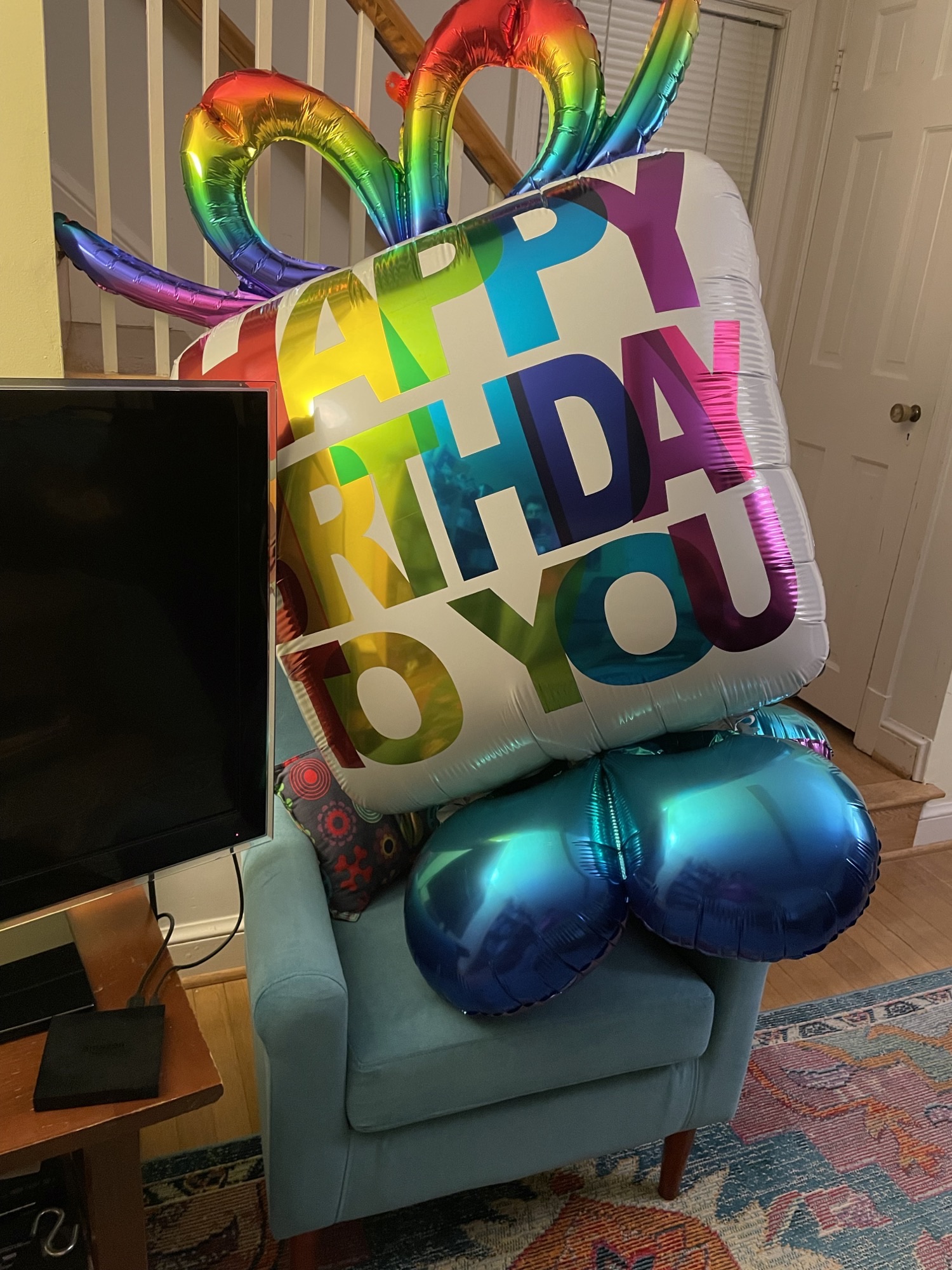
Yesterday for Sarah’s birthday Max walked up to Safeway to purchase a birthday balloon for Sarah as we always did. I had gotten her a card from us and in the early evening we were going to have Birthday Bear and Old Guy do their thing (see yesterday’s post). He came back with the most enormous balloon, one of those gigantic mylar monsters about 4 or 5 feet tall. It was the only Happy Birthday balloon in the store, he told me. And because it was Presidents’ Day, no one was working in the floral/balloon shop at Safeway and the other employees said they were not allowed to run the helium dispenser and blow up balloons from the rack. Max didn’t want to purchase a Happy Anniversary balloon or some other kind so he got this huge balloon for Sarah.
When he got home we started laughing about how Sarah had arranged things at Safeway for herself to get this huge balloon. Well played, Sarah! I guess this is sort of folie a deux. I’m sure Mark would not approve.
-
Where is Sarah?

This morning I woke very early from a dream in which I think I was hunting for Sarah but happened upon my mother, who also died recently. I wanted information from Mom on Sarah’s whereabouts, but she began a long spiel about her medical problems, which is what usually happened when you talked to her in real life. Thanks for keeping it real, Mom. The dream also included something about a bus trip, and taking care of kids and a puppy, but I’m not going to recount that because it’s pretty boring to hear about other peoples’ dreams.
I was disappointed during the dream, and when I woke up around 3:45, that I didn’t get to see Sarah. Max apparently dreams about Sarah a lot. In his dreams, she’s driving a big truck or car and we’re in the back seat, and she’s driving in a very outrageous and impish manner, which I could see her doing, and laughing at our concerns. I haven’t had any dreams about Sarah, at least not that I can remember, which makes me feel bad.
I would really like to see Sarah set up somewhere fun and safe, like a beachfront dorm for dead children with all the amenities and proper chaperones. Sort of like Give Kids the World, the resort at Disney where we stayed when we did her Make-A-Wish trip when she was 10. It was all set up for sick and disabled kids and we absolutely loved it. Christmas and Halloween were celebrated every week there. There was an ice cream parlor open 24 hours to tempt feeble sick kid appetites, small rides that wheelchairs could fit on, and just tons of other stuff like accessible miniature golf, a carousel, a beauty spa where the kids could get makeovers to look like superheros, and many other fun activities. And of course the Disney and Universal characters came to the resort and Mickey and Minnie would show up in the dining room at breakfast and so forth. It was insanely fun.
I would like to see Sarah somewhere like Give Kids The World. She was in ecstasy there. Friends have written some emails and letters saying that Sarah is an angel in heaven or that she is with our father now, and that is also a comforting thought. Judaism does not have a precise theology of heaven and afterlife. That is because as a religion we are more about actions than beliefs (thank you, Rabbi Jennifer Singer, and your blog for helping me pin this thought down).
Although I like to think of Sarah having a great time at GKTW or the Jersey Shore, I also like to think of her close to me, hanging around the house. Today is her birthday and Max and I agreed we are going to get her cards and a balloon, and we will have Birthday Bear and the Old Guy sing for her. Birthday Bear/Old Guy are singing stuffies who sing the Happy Birthday song when activated. Birthday Bear just does it straight up, and OG makes farting noises with his rendition, a great favorite of Sarah. Wherever she is, I hope there are fellow lovers of fart jokes.
-
Deep winter thoughts
I’m not in a good place this morning. That business about letting go of resentment that I wrote about a few days ago seems to have come back to mock me. I have finally gotten around to watching a webcast of a seminar at National Institutes of Health last spring, ‘De Novo SPG4 Inaugural Symposium.’ I had this on my watchlist since last May and never got around to it. It’s a bunch of scientific presentations about Sarah’s rare genetic disorder.
At the beginning of the conference there were a couple of parents from the Cure SPG4 Foundation who talked about their kids who have the disorder. There was a slide show of the kids, who were at that ultra-adorable 4 or 5 year-old stage, one using a wheelchair and one a walker. It was the usual piffle from the parents about how little Johnny is super-confident, nothing gets him down; Edwina does everything her brothers and sisters do, always a smile on Edwina’s face, blah blah blah. I felt like screaming “Your kids are toast!” the whole time, and when they talked about looking forward to a cure for SPG-4, I compassionately informed them (from my muted screen) that their kids were “dead meat.” Yes, I’m really feeling quite neighborly today.
When Sarah was 5ish, we hoped for a cure too. We didn’t know she had SPG4 specifically back then but we hoped that some medication or therapy would get her walking and/or talking. It was almost impossible to imagine then that she could be 10 or 15 and still significantly disabled. I hoped for deep-brain stimulation to be an answer or some sort of scenario like in the movie Lorenzo’s Oil. I’m certainly not in the position of the dad, Augusto Odone, in that movie, earning an honorary scientific doctorate for helping to track down answers to adrenoleukodystrophy. I was really pushed to my limits trying to understand some of the speakers at the SPG-4 symposium and their talk of missense mutations, microtubules, AAV9 vectors, and so forth.
What I can glean is that Sarah had a gene mutation known as a “missense mutation” which means a substitution of one amino acid for another in all her cells. She didn’t inherit it from us, it was brand new. (Another example of a missense mutation is sickle cell anemia disease). This mutation was present in all her cells and altered the function of a protein coding gene called Spast. This gene provides instructions for producing a protein called spastin that is found throughout the body, particularly in certain nerve cells (neurons). “The spastin protein plays a role in the function of microtubules, which are rigid, hollow fibers that make up the cell’s structural framework (the cytoskeleton). Microtubules are also involved in transporting cell compartments (organelles) and facilitating cell division. Spastin likely helps regulate microtubule length and disassemble microtubule structures when they are no longer needed.” (National Library of Medicine).
That’s where I start to drift off. (Part of me feels like, Go Sarah! That’s my creative girl! You arrange your genes exactly like you want them! Subsitute those amino acids!).
The presentations I listened to included the longitudinal study from Boston Children’s Hospital that Sarah was enrolled in at the time of her death that included all the early onset, complex SPG4 kids they could find world-wide. They apparently have 496 as of the date of the presentation last April. There were also reports on the “mouse models” and so forth they are doing to work toward cures.
I wish I could say I listened to the presentations with a glad and thankful heart for all science was doing for my deceased daughter’s rare condition. I did not. I listened and my overwhelming thought was “What about Sarah? When are you going to talk about Sarah?” Which of course would not be appropriate in any case, not to mention the fact that this conference took place last April when she was still alive.
I’m just feeling pretty bleak and cruddy.
-
Childless

This is Presidents Day weekend, Sarah’s birthday weekend. We are planning to go out to dinner on Sunday with Sarah’s tutor, who we were all close to, but have vague “we’ll do something” plans for Monday. Perhaps I will get a pedicure with purple or pink polish.
This morning I read a BBC News article which explained the difference between “child-free” couples, who apparently are celebrating their lifestyle, and childless couples, which is what we are now. Child-free couples consciously decided to never have children and do not want to live or socialize around them. Childless couples want children in the future or hope to have them or were affected by social or medical circumstances. Unfortunately, says the BBC, academic research tends to lump both groups together although they have very different experiences and attitudes. Well, I would think so.
I still want to be around kids to whatever extent is natural and I like seeing pictures of my friends’ kids. A lot of people ask us if we stay in touch with Sarah’s friends and the answer is yes and no. Most of Sarah’s long-term friends were also special needs and most of the contact was parent-to-parent. Sarah’s BFF since kindergarten was Aisatu, a little girl she met in her Augmentative Communication Class who made a beeline for her with her walker and hugged and kissed her. They maintained a friendship through the years although they weren’t in the same school after Second Grade. They went to ballet together and did play dates and birthday parties up until COVID. Aisatu came to Sarah’s funeral and I’m still in touch with her mom. I love her and miss her.
Starting in Sixth Grade Sarah formed a special friendship that evolved into something of a romance/boyfriend relationship with Danny, another special needs kid. They were together at the same school through Ninth Grade and would have continued at the same school through the end of high school. We loved Danny, who had Down Syndrome, and Sarah adored him. They liked to go the movies, to Facetime, to make presents for each other at Build-a-Bear, and silly JibJabs, and Danny wrote Sarah some really nice notes telling her he loved her that she put up next to her bed where she could see them.
Toward the end of Ninth Grade we also received news from the school that Sarah seemed to be forming a quasi-romantic attachment with Sammy, another kid in the class who was in fact Danny’s best friend. We were pretty surprised, but neither my husband nor I had dated when we were in high school so Sarah was really showing us the ropes in this area. Sammy’s parents contacted us and invited us over for dinner and to share Sammy’s birthday cake and we were delighted to go. The four parents had a great evening discussing the kids, who spent all their time on their phone and ipad respectively. Sammy’s parents told us that he had been attached to Jessica, another girl in the class, since Sixth Grade, and we explained about Sarah and Danny. Apparently Sammy and Sarah were more of a back-up arrangement to the main attachments. I marveled at Sarah’s ability to play the field and juggle multiple relationships.
When Sarah died suddenly it was the week before school was about to start and many families were away, catching a last few days of vacation. We reached out to the families of kids she went to school with but a lot of the special needs kids were scared and upset. Danny’s parents said they were trying to persuade him to come over with flowers but he was too scared. I told them not to push him. I have not heard from them since then. Sammy’s parents said they would be at the funeral but we did not see them there. They both work full-time and I don’t blame them for not taking that Monday off; they probably couldn’t.
It’s hard to lose these kids too as well as Sarah. We loved them and we delighted in their relationships with Sarah. They were part of our life too.
-
Untitled
These last few days my usual emotional repertoire since August 18 of guilt, depression, angst, and constant tearfulness seems different. A couple of nights ago, I woke up from a dream screaming. I remember that someone was trying to steal the new car I bought in place of our wheelchair van, and leave me three strange children instead. I was very irate in the dream and it was one of those dreams where you can’t speak and are desperately trying. Max said I woke him up screaming “That’s my f*cking daughter!” The dream scared me. There was a lot of anger in it.
It scares me to admit that I feel angry with Sarah but it seems like the last few days I have been. Today I picked up my phone and saw her picture and I thought “Can’t you leave me alone for a little while?” It shocked me and I felt terrible, as if I had actually said that to her in real life, something we would never have done. Sarah wasn’t capable of generating her own activities and amusements or going off and playing by herself in the backyard or something. Considering how dependent she was, her amicable, easygoing personality was definitely a plus. She didn’t tantrum or shriek; she wasn’t physically capable of a real meltdown. She had a pout that she put on if she didn’t get her own way that was more adorable and funny than anything else. And she was persistent if she wanted something; she would just keep asking, with a smile, usually until we gave in.
We tried to structure her day around the things we knew she liked to do and create a routine for her, and of course she was in school every day too. COVID was a hard period, but my husband retired and went to Eighth Grade every day on Zoom with Sarah to make sure she learned something and had support.
I can’t say Sarah ever made me angry when she was alive. I remember once when she was about a year old she was sitting in her Bumbo seat near me and she kept pulling on the cord of the mouse when I was trying to type something and I was irritated, but Max came and took her away and found her something to play with. Another time comes to mind when Sarah was almost five and we were all lying on the floor together posing for a holiday card which a friend was photographing, and Sarah shrieked really loudly with delight in Max’s ear and he said “Ouch, Sarah, that hurt” and she cried and cried, she really felt reprimanded.
Max has expressed a lot of anger since Sarah’s death, but more of an inchoate kind of anger: at the world, at his “higher power,” at himself because he feels he slept too deeply somehow and should have heard some sort of struggle that night, or Sarah crying out for him (which is nonsense, I think). I don’t think he’s feeling any anger with her. Maybe I’ll ask him when he wakes up.
-
True Facts
Little kids, and sometimes adults too, used to come up to me and ask me “What’s wrong with her?” when I was out and about with Sarah. I don’t blame kids for having questions but there was never any good answer and I sucked at handling this situation. Sarah understood everything that was said around her and she hated it too. She did not like having her disability discussed with strangers. Well, who would?
There was never any easy way to explain what was “wrong” with Sarah and it took many years and a lot of missteps to find out. Pregnancy and birth were perfectly normal and I passed all the prenatal tests, including amnioscentesis and genetic screenings. I remember Max and I casually saying when I was pregnant that if there were a problem, we would terminate. I was so ignorant and unknowing then.
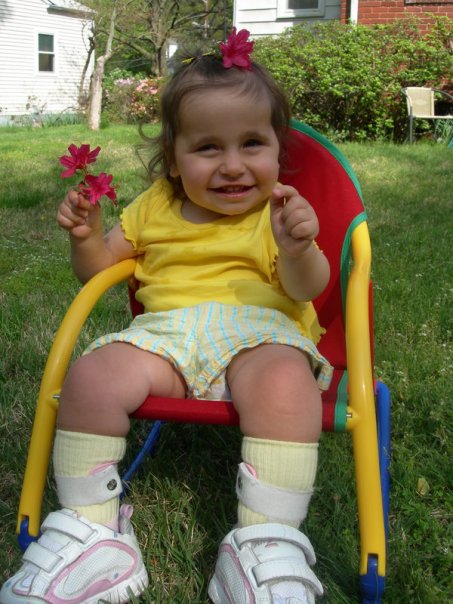
Sarah was born full-term and other than being a little on the small side (5 lbs, 14 oz), she was a typical infant. I remember my brother reassured me she would be ten pounds in no time, and she took to nursing like a champ, plumping up beautifully. We ended up nursing together for 19 months. Doctors and physical therapists always seem amazed that she had no problems nursing considering all her other issues, but perhaps her high arched palate, which is a symptom of her condition, helped in that area.
Early on she was perfectly normal, even a bit advanced in her acquisition of vocabulary. She said DaDa at six months and added some words steadily after that. She smiled, laughed, was very social, and loved Peekaboo. Around this time I was involved with an online mothers’ group who all had babies born the same month. We moms had “stickies” we put on our posts when our babies achieved milestones such as “I can roll over!” and “I can sit independently!” and even “I can crawl!” I began to notice that a lot of the babies had all these stickies. Sarah had stickies for her first word and her social smile, but she didn’t have any stickies for physical development. She wasn’t even playing with her feet or even really noticing their existence.
I talked to our pediatrician at the six month visit and she advised watchful waiting. A lot of kids were meeting milestones later because of the sleep-on-your-back movement. She didn’t feel Sarah had any signs of delay. Perhaps I was extra watchful because my nephew, my brother’s youngest son, had been through Early Intervention due to hypotonia. He hadn’t been walking at 20 months, but a referral to Early Intervention got him walking and he was fine by age 3. I also didn’t walk until 19 months, and my father was apparently a late walker too. I felt if there were a family history of hypotonia we should be proactive. So when Sarah hadn’t rolled over or sat up by nine months, we contacted Early Intervention in our county. We assumed, and her working diagnosis at that point, was hypotonia.
Sarah had a great time with the therapists at Early Intervention who worked hard with her until her third birthday, but she never really made progress. She did learn how to roll over with a great deal of effort, sort of like watching a turtle right itself when it lands on its shell, but she didn’t crawl, walk, stand, or sit independently. At that age, she could still use her hands and arms pretty much normally. She was also having some regression issues with her speech in terms of not using words she had used in the past and we started private speech therapy.
During this period we took Sarah to a neurologist at Children’s Hospital and she had a number of tests, including a brain MRI, which did not clearly show much of anything. But over the next months there was a fight among the neurologists and radiologists interpreting the MRI about very subtle signs of white matter syndrome, basal ganglia undersignaling, hypoxia, and other such fun terms. I remember one neuroradiologist called me and told me Sarah definitely had White Matter Syndrome. I googled all about it, joined a support group, bought a t-shirt supporting a foundation, and was settling nicely into my role as a White Matter Syndrome mom when our lead neurologist came back from vacation, called us, and said that Sarah definitely did not have White Matter Syndrome, there were absolutely zero signs of that on Sarah’s MRI. For the love of God.
I should mention that we did a lot of genetic testing, but this was around 2007 or 2008, and genetic testing was pretty raw. They suspected a possible mitochondrial disorder, but couldn’t find one in the testing results. It was explained to us that mitochondrial disorders were often very hard to detect. At around this time (Sarah Age 2), a good friend of ours recommended that we go to Kennedy-Krieger Institute in Baltimore and see the wonderful Alec Hoon, the head of the Movement Disorders Clinic there (now retired). Dr. Hoon became our mentor and the head of Sarah’s team.
Dr. Hoon told us that Sarah had cerebral palsy, which is not a diagnosis but is a description of the condition of her muscles and overall physical and neurological functioning. It felt like a relief to us to know this and have someone say it flat out. He said we needed to discover the cause of her condition. It used to be that people thought that CP was caused by lack of oxygen at birth, but now they know that it’s usually caused by a variety of genetic factors. So he included on our team a great neurogeneticist, Dr. Ali Fatemi.
Dr. Fatemi also felt strongly that Sarah had a genetic mitochondrial disorder, and he started trying to track it down. But the gene testing technology had to catch up with us, and it didn’t until 2013, when whole exome testing became available. Sarah, Max, and I sent a little vial of our spit in to a private company and about a year later we got a report that said Sarah had a condition called Hereditary Spastic Paraplegia, Type SPG-4. An illness that usually impacts people in their 40’s and 50’s. And not only that, for her, it wasn’t hereditary, it was a mutation in a gene. And it wasn’t spastic, it was dystonic. And it wasn’t paraplegia, it was quadriplegia.
Yes, we were befuddled and aggravated. This is the answer? An illness that doesn’t fit her condition? A gene that causes middle-aged people to walk funny? How does this explain anything? We even took Sarah out to Michigan, to the “guru” of SPG-4, to see if there was anything about her condition which was tell-tale or need-to-know. His opinion was that she had cerebral palsy, and the SPG-4 diagnosis was just a coincidental overlay.
So we pretty much forgot about or didn’t think about the SPG-4 diagnosis for several years. We concentrated on therapies and we explained to Sarah that she had cerebral palsy. Meanwhile, Sarah was losing skills, which is not a hallmark of cerebral palsy. Cerebral palsy is not a progressive illness.
One day when Sarah was about 11, I was out at her therapeutic horseback riding group, chatting with another mother. We wondered why the group teacher gave the girls “report cards” for their horsebackriding progress the way typical kids get. “These kids are not going to progress with skills,” we agreed. The other mother then became upset and starting telling me she didn’t understand something about her daughter, a girl Sarah’s age. “She has never met a single goal in physical therapy,” she told me. “Not one.” She was clearly baffled. “I just don’t understand it.” What diagnosis does your daughter have, I asked her? “SPG-7.”
I had never met another child before with SPG and it was like a light went off in my head. This is progressive. This isn’t cerebral palsy. But I had no validation until 2020, when we were contacted by our genetic counselor. She told us that research now showed there are two subtypes of SPG-4, an uncomplicated type, which is the kind that manifests in middle age with trouble walking, and a complex infantile type that starts in early childhood, that is progressive and involves the entire body, plus intellectual disability and some distinctive features. Now you tell us, I thought.
-
Foster Children
I think I have mentioned before that I have come to have something of a compulsion for watching documentaries. I guess it helps me take the edge off somehow. In the beginning, I started watching true crime and survival stories, and I definitely had the thought in mind “If they can survive that, I can survive this.” Now I seem to just be going through HBO and Netflix’s playlist and I freely admit I have watched a ton of crap amidst some very good ones. (Feel free to ask for recommendations.)
Last weekend I watched “Valentine Road” on HBO, which was very moving but has led to a variety of irrational thoughts and strange fantasies on my part. You may have heard in the news a few years ago (more than a decade now) of the California middle school student who shot and murdered a transgendered kid. This documentary told the whole story. The victim was an 8th grade kid in the foster/shelter network who wore girl’s clothes and make-up and was clearly in the process of transitioning and trying out a new female identity. It’s painful to see how the school administration (mis)handled it, with a “behavior plan” for the victim and lots of blaming the victim for “bullying” or harassing classmates or disrupting class (by simply dressing up, by expressing feelings of attraction to boys, or by just maintaining their preferred gender identity.) Ultimately, another eighth grader who was apparently a budding neo-nazi as well as deeply screwed-up, and of course homophic, shot to death Larry/LaTonya/Laticia in the middle of computer class. Of course, the icing on the cake of horribleness is that the county prosecutor then goes after the 14 year-old shooter determined to try him as an adult and put him away for life.
In my weird grief-informed fantasies this week, Larry/Latonya/Laticia is living with us as a foster child. LLL can go to 8th Grade at my daughter’s middle school, which was very supportive of transgendered kids and quirky and special needs kids in general. Certainly LLL will have an appropriate IEP, if necessary, because I will be there to make sure it gets done. We can use the same lawyer we used for Sarah. I will raise hell if there is any sort of attempt to accuse LLL of “disturbing” other children or staff, or to victim blame LLL. And, since LLL is a tiny and petite kid for 13, LLL can probably wear a lot of Sarah’s clothes if LLL wants to. LLL can also experiment with my make-up and jewelry, since I never wear any anymore. I will also have the fun of shopping for clothes for LLL once I know LLL’s tastes and sizes. Right now their taste seems to run to high heels and stretch polyester judging from the documentary, but maybe LLL just needs a mom to help work on a daytime look for school that’s fun and feminine but not totally over the top.
As you can see, I’ve pretty much lost all self-control. And since LLL is, in fact, dead, they won’t be moving in with us any time soon.
I guess this fantasy fulfills my wish to be a mother again, to take care of someone, to protect them, accept them, help them, and to do justice for them, all the things that I think a parent should be and do.
For those of you who are probably asking the obvious questions, we have no other children, and we are too old to have more naturally (or with medical intervention). I was 41 when I got pregnant with Sarah, and although it was an easy conception and pregnancy, I wouldn’t go through the newborn stage again, ever, for anything. We have talked about having an older foster child, perhaps a special needs foster child, or doing some kind of respite care for special needs families, but I don’t think we’re ready. The only child we really want right now, despite my needy fantasies, is Sarah.
-
Love

So I did end up buying a Valentine card for Sarah. It has a heart theme with multiple pages that you open with a silly question on each page like “Who is the girl that millions adore? Who is the one that makes my heart soar?” and so forth until you get to the middle page of the card and it says YOU ARE! That is the kind of joke and little puzzle my sweet dumpling loved. I can see her face lighting up at the revelation that IT’S HER, and her big beaming smile.
This combination of Sarah’s joyfulness and her intellectual disability was one of the things I loved most about her. She wasn’t happy one hundred percent of the time but she had a very amiable personality that people commented on and responded to from babyhood. She was social and loved interacting with people and had a great deal of charm. And there was her smile, of course, which was delightful.
My husband Max thinks that part of our legacy to Sarah should be to be more like her. To be happy whenever possible. To take real joy in things. To smile more. To love others. To be grateful. And so forth.
I’m generally not good with these sorts of overarching concepts. I mean, happiness, gratitude, patience are all good things but I’ve never cared for the gratitude industrialization complex that seems to pop up regularly on the Internet, with friends informing that they are going to be announcing 32 days of things they are grateful for, or some such. Then you get the usual lists of family, house, day of good weather, etc. until they really start scraping the bottom of the barrel and are telling you they are grateful for Hellman’s Mayonnaise or some such. Ditto the mandatory gratitude statements at Thanksgiving Dinner that can be such torture for depressed people and special needs families.
However, I love my husband, and I want to support him, even though he can be a bit “12-Steppy” at times. So here are some things I’m grateful for surrounding Sarah’s death:
- I’m grateful that Sarah did not outlive us. I think this is the anxiety of every parent of a child with severe disabilities: what will become of my child after I am gone? Even if you set up trusts and arrangements and so forth, there’s no one to care for your child the way you do. I couldn’t stand the thought of her alone without us.
- I’m grateful that Sarah is out of pain. The last few years were not easy. Sarah became anxious during COVID and didn’t want to leave the house at all. (None of us ended up getting the illness, which was a relief). She started having seizures. She had some GI issues, and lost and then gained weight back, and had some skin integrity issues. The contractures in her feet were getting severe. I was very worried about her.
- I’m grateful that she did not have to deal with turning 21 and high school ending and “the cliff” of social services, etc., falling off after that. Sarah loved school and her friends and teachers there. That transition would have been terribly hard for her.
- I’m grateful that I did not find Sarah after she died, and I did not have to see her with her face blue or to attempt CPR and other life-saving measures and try to find a funeral home. I think this was a horrible experience for my husband.
- I’m grateful for my husband and the closeness we feel right now. When Sarah was alive, so many “statistics” were thrown in our face about our marriage not lasting because of a special needs child. Now that she’s dead, apparently the same vague statistics predict imminent divorce. I don’t think this is going to happen.
- I’m grateful that a lot of anger seems to have left me. When Sarah was alive I carried around a lot of defensiveness and resentment and it came out in a lot of ways. I also rushed all the time and felt very impatient. I don’t seem to have those forces driving me so much anymore and I feel grateful.
- I’m grateful that I don’t have to drive our beat-up, clunky, beast of a wheelchair van around anymore, with its sticky ramp and scratched-up exterior and only one place in the whole area that could tune it up or provide maintenance.
But most of all, I’m grateful that I had 16 years, 5 months and 28 days of Sarah’s love.
-
Balloons

Tomorrow is Valentines’ Day, which was one of Sarah’s very favorite holidays. It’s hard to say that there was a holiday she did not like celebrating: birthdays most of all (her own, ours, her friends’), V-Day, Hanukkah, Christmas, Halloween, Thanksgiving, Fathers and Mothers Days, and any other holiday for which the grocery stores produced balloons and/or for which she could be taken to Build-a-Bear to make a stuffed animal for herself or someone else. Earlier in life, before she needed a feeding tube, she was also a big fan of cake and ice cream. She loved collecting candy on Halloween and Valentines’ Day and just having it all dumped in her lap so she could see how much loot she had. She was always proud when she collected a lot, and then of course Max and I nibbled away at the stash over the next few days.
So this morning I’ve been feeling somewhat on the fence as to whether I should get her a Valentine for tomorrow. I always got her a frilly girly card telling her how much I loved her with a cartoon or Disney theme. I was thinking I could put this year’s card near her urn. I certainly don’t want her to feel forgotten tomorrow but I don’t want to work myself up into some sort of ritualistic compulsion to purchase cards and provide things for her as if I’m serving a Cargo Cult or idol. I have a tendency toward compulsion and I don’t want to feed that.
This is even more complicated by the fact that February is Sarah’s birthday month as well. It’s going to be difficult to see her 17th birthday come and go and know that she never reached it. She lived to be 16 years, five months, and 28 days old. I remember when I turned 17. For some reason I worked myself up into a state of anxiety (surprise!) because I felt that I was “old” and nothing had “happened to me.” I remember crying because I felt my life had held no meaningful events and I was somehow past my prime and missed my chance. (All I can say is that I vaguely remember that Madame Mao was very much in the news at approximately that time and guess I must have thought she really made something of herself?)
I remember my parents consoling me that 17 was still very young and that many things would happen to me as I got older, went to college, and so forth. I am sure they did not foresee the death of a child as one of those things. I wish sometimes that I could go back to that stage of my life and live my life over, somehow differently, to avoid this happening. But would I have wanted not to know Sarah, to not have 16 years, five months and 28 days with her? No.
-
Subscribe
Subscribed
Have a WordPress.com account? Log in now.

