-
PTSD
Yesterday afternoon I got a text from my father telling me that my sister-in-law is in the hospital due to a serious health issue that occurred while she and my brother were vacationing. She is in good hands, but will have to have some surgery and remain in the hospital for a couple of weeks.
My older brother is a rational and slightly pedantic person who has assured me that her condition is “eminently treatable” (his words) and so has Dr. Google. But my mind keeps zapping me with the idea that death is back, and I need to prepare. That this is Death Number 3 and they always come in threes. I’m not close friends with my sister-in-law, but this prospect is very upsetting for me.
My mother died about eleven months before Sarah. She broke her hip in a fall in February 2021 and entered nursing home care during the height of the pandemic. She lived for another six months before dying in September 2021 at age 86. Like Sarah, she did not wake up one day. I do miss my mother, but her time spent in nursing care was such an ordeal for her, and the cognitive dysfunction she experienced was so hard at times to cope with, that her death seemed like a release and a relief in many ways.
I did not have a period of intense grief after she died, but three or four months later, I became very depressed for a while concerning a work situation I was going through. It was a troubling situation, but my reaction and depression were so out of proportion that both my husband and Dr. Z felt that I was having a delayed reaction to my mother’s death. Probably, they were right. It was easier for me somehow to react in a big way to this work situation than to her death.
For many years before Sarah died, I was anxious and wary if she slept late that she could be dead. There had been a couple of special needs kids we knew who “woke up dead” and this reinforced the anxiety. Of course, we’ve learned of many more cases since Sarah’s death. Sudden death or epileptic bed death is also a risk factor with seizures.
I always felt somehow I could guard against Sarah not waking up and ensure it did not happen. Maybe that’s why I habitually wake up at 5 a.m. During the week Sarah got up pretty early to catch the school bus, and would often get up at the same time on weekends, but sometimes would sleep later. I’d tiptoe close to her door and listen.
I do the same now for Max, and for Polly our dog, who is 11 years old, because I have fears that they won’t wake up. Dr. Z says I have a form of PTSD, post-traumatic stress disorder. He says one of the symptoms is this pattern of constantly fearing a repeat of the traumatic event.
Before Sarah, and before my mother, I tended to look at death as a drawn-out sort of affair in which the entire family participated. The dying person, in my imagination, had a slow and steady decline, perhaps entered hospice. There were medical personnel saying “It’ll be any day now” and “You’ll want to get here fast” and the family gathered. Perhaps the soon-to-be-dead person experienced agonal breathing or end of life hiccups or whatever symptoms the hospice videos talk about. For special needs kids, there’s always talk about pneumonia being the cause, and how eventually antibiotics stop working and the child dies in the hospital. But Sarah had never had pneumonia. She’d never had any kind of lung or chest infection.
For Sarah and my mother, death was sudden. We were given no time to prepare. Having paused for a few minutes to think about it, I suppose there are some advantages to this. They were probably not frightened. I would not have wanted Sarah to be scared or to have to leave home or be in the hospital. She hated the hospital. I’m glad it was fast for her.
I just can’t give up the notion that I could somehow have controlled or prevented this if I had been home. I know that’s very egocentric. My husband feels equally guilty, because he WAS home and it happened on his ‘watch’. We found out that Graciela the babysitter, who I mentioned in my last post, was also traumatized by the whole thing and was texting and emailing with our across-the-street neighbor for several months. Apparently, there’s guilt and PTSD for all of us.
-
Valhoma
There’s no word in our culture to describe the unique status of a parent who has lost a child to early death, the way we would say ‘widow’ or widower about a bereaved spouse, or orphan about a child with dead parents. A few months ago as I was cruising the Death and Grief Internet, (not to be confused with the dark web), I came across an article that is trying to make the Sanskrit word “Vilomah” happen for us.
According to joincake.com (9/14/22), “Karla Holloway, a James B. Duke professor of English at Duke University, coined the term after suffering the loss of a child and discovering that there was no word that gave meaning to a parent whose child has died.”
I’ve tried my best to remember Vilomah but I always seem to think of it as Valhomah, sort of like a combination of Valhalla, the Viking afterworld, and some sort of metastisizing tumor. It’s not a very appealing word, all due respect to Sanskrit to which all Indo-European languages seem to owe a great debt. Although I feel a bit like Regina from Mean Girls telling Gretchen that Fetch isn’t going to happen, I don’t think I’m going to go with it. Maybe any word would be unappealing that describes this state of being.
This week we gave away some of Sarah’s large medical equipment to a family that really needed it. Our insurance was always good and we were able to get durable medical equipment to support her. Another family needed her Rifton Tram, which is a sort of small medical forklift that you can use inside your house to help assist with moving a child from room to room who cannot walk or stand unassisted. Sarah had a Rifton Tram at school and she could use it as a “stander” when doing art or other such things (it’s important for kids like her to stand so they can lay down calcium on their hips), and there was one at her weekly physical therapy too. So we got together the various letters of medical necessity and so forth and asked our insurer to pre-approve one for her at home. Of course, we got turned down the first few times but within two years we had the Tram.
I can’t say after that we used it a great deal. It was cumbersome and it took up a lot of room and time in our small house. We also had an established routine for Sarah’s transfers using her stroller wheelchair in which we pretended it was an airplane or a train and I think she didn’t want to give that up, and neither did we. Anyway, we really didn’t do much with the Rifton Tram so it didn’t make me anxious to ask Becky, Sarah’s physical therapist, if she had another family that needed it that we could pass it on to.
It’s so hard to think of giving away Sarah’s wheelchairs right now, or her speech-generating device with eye-gaze. They feel like parts of her body. Especially her talker. There are so many bits and pieces of her personality on there. The page of knock-knock jokes that she loved to torture us with. All the games she loved to play. I don’t know if I will ever be ready to let go of those things. Or to change her room.
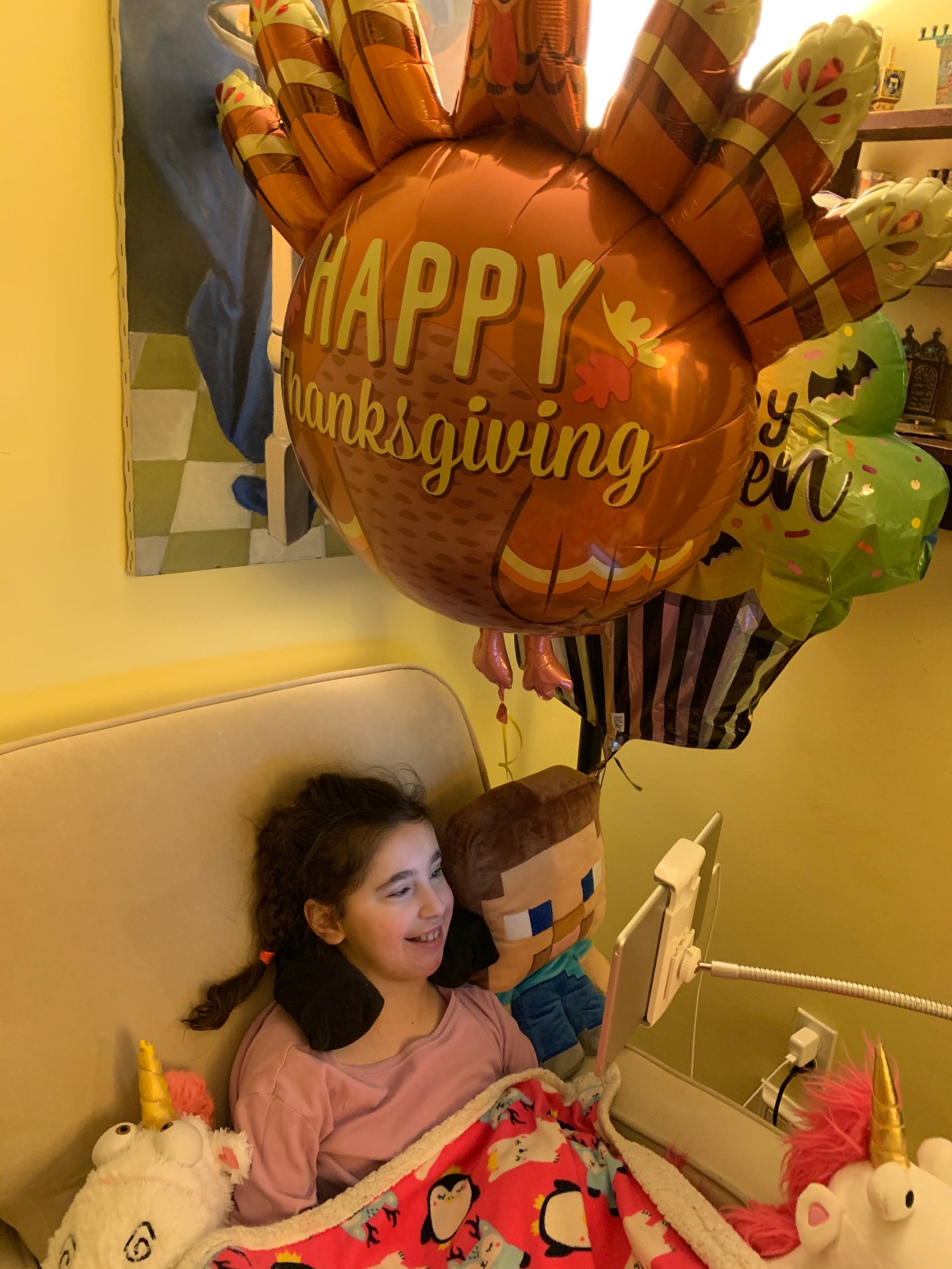
Right now there are 3 or 4 dead balloons in her room. Sarah loved large mylar balloons and she had a trio of Happy Birthday ones leftover from my husband’s birthday a few weeks before her death, and then Max got her one when I was away in the shape of a watermelon slice that says “Sweet Summer.” I guess someday we will have to do something with them.
-
Taconic Parkway

It seems to be the symbol of all my guilt and grief at this point. Why? I was not at home when Sarah died. I had gone up to New York City on Tuesday afternoon August 16 to help my Dad, who is 90, tour an independent living facility in Albany. It was so rare for me to leave Sarah, and she didn’t want me to go. Of course she had her father with her. I also hired a caregiver to come in during the days, 9 to 5, while I was away. My husband has a really hard time functioning in the mornings and also, you need breaks when taking care of Sarah or really any other kid. You can’t do it alone.
The caregiver really just needed to be there in the same room with her, because she was really happy watching YouTube videos, playing Minecraft and so forth, and she also needed to be changed. She was potty trained for poo since she was two and rarely had accidents but wore pull-ups for pee. She didn’t have the muscle control to urinate on the toilet. She also needed help repositioning and getting comfortable. And she needed company too and interaction.
Our long-term caregiver, Mrs. M., had a Covid baby and was unavailable. I had to cast around for someone else for the Tuesday afternoon to Thursday afternoon I would be away. I found a school system paraeducator who worked with special needs kids for extra money. I don’t remember her name; let’s call her Graciela. Graciela certainly understood Sarah’s disabilities but she seemed used to much younger children. Tuesday before I left I could see that Graciela was speaking to Sarah in that idiotic sing-song tone of voice that people use for the disabled sometimes. She also was trying to structure Sarah’s time into 15 minute increments, as if Sarah were at pre-school, telling her it was time to turn off the Ipad and practice her eyegaze communication device or some such thing. Max and I cautioned Graciela that Sarah was free to do whatever she wanted for however long she wanted, and that her eyegaze should not be used as some sort of chore for her. Graciela listened, but not really. It was obvious that Sarah was not particularly pleased with Graciela. Max and I agreed that Graciela would have to be monitored and reined in.
I gave Sarah big kisses around noon on Tuesday August 16 and got into our wheelchair van for the drive to NYC. There was a family dinner that night with my father, brother, sister-in-law, nephews and niece. I spoke to Sarah and Max around five pm, with more kisses, and again to Max around ten. Wednesday morning the 17th Dad and I drove from the city up the Taconic Parkway to outside Albany. My father liked the facility but seemed uninterested in actually moving there. We stayed in a hotel that night. I spoke to Sarah and Max again at dinner time. I told her I would see her the next day, Thursday, and I couldn’t wait to give her a thousand kisses. She squealed and sighed happily. Max said it was obvious that she didn’t like Graciela very much but she was doing fine.
On Thursday the 18th Dad and I set off back down the Taconic Parkway first thing in the morning after breakfast. We initially got lost and went the wrong way but I was able to turn around and head in the right direction to NYC. I took my Dad to his apartment building on the Upper West Side in NYC and then l saw that I had multiple messages from Max in my voicemail and texts too. I called and, sobbing, he told me that Sarah had died, that he went into her room because she had slept late and found her blue in the face and called the rescue squad. I couldn’t process this information. I thought he was making a mistake, that he had mixed up Sarah’s name with that of Polly, our dog, and that he meant that Polly had died.
Sarah had seizures, pretty well controlled with Lamictal, so the working theory is that she may have died during a seizure. But no one knows. The hardest thing for me is that I wasn’t there. I was on the Taconic Parkway.
-
I Hope You’re Getting Good Support
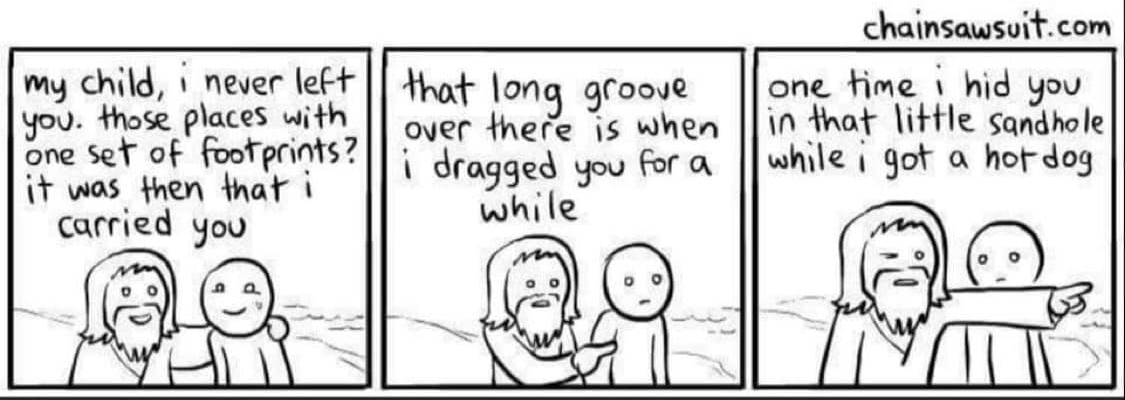
This has to be among my least favorite things for people to say to me. There seems to be an implied “But not from me” at the end of it, as if the Venn Diagram of Support offers a large, vast interlocking network of caretakers and caregivers and groups and therapists and so forth keeping me “grieving well” (another expression I loathe), but the speaker is off somewhere completely outside and disconnected. It also seems to imply that there’s some particular key to finding comfort, and we grievers have to be on our toes about tracking in down. Tut, tut.
We do belong to a support group for child loss. It meets once a month by Zoom, which is not a lot. It’s run by a local social services agency. Initially, we contacted, and were contacted by, Compassionate Friends but there was something very corporate about them, their emails, phone calls, their sending us bookmarks with their logo. We started calling them Pushy Friends. I guess introverts like us have that feeling that any group that wants us that badly isn’t worth joining.
For about a week I had the irrational thought that I should join Parents of Murdered Children, just another on the list of irrational thoughts about Sarah’s sudden, unexpected death. Of course that’s inappropriate and disrespectful to real parents of murdered children. And also, I’m glad I didn’t do that because I watched a documentary the other day that showed some parents at a meeting of POMC discussing how prisoners should have all their civil rights taken away. I can’t blame them for thinking that way in their extreme grief, but that would not be the place for me to feel comfortable.
We reached out to an organization that supports parents who experience sudden unexplained death in childhood, but they made us feel that Sarah’s death wasn’t sudden and unexplained because of her underlying medical condition. Apparently in order to be truly sudden and unexplained, there has to be an alien abduction or a sudden collapse of a typical child. I really gave it to them in their feedback survey.
What is “good support?” I think the best support is hearing other stories like ours, parents who have lost children suddenly and unexpectedly. Especially special needs children. I’m not sure people realize the intense love and bond we had with Sarah, and the intense grief of losing a child like her. Yes, it was a different kind of child-raising experience from raising a typical child. But it was beautiful and happy.
-
Things I Never Wanted To Change

This morning when I got up as usual at a little before 4 a.m. and scanned three or four news websites, I came across an article in the New York Times stating that elite Supreme Court clerks (these are the young lawyers that assist the judges in writing decisions for a year or two, for those who don’t know or care) tend to not only graduate from Harvard or Yale Law School, but also tend to have been undergraduates from Harvard, Yale, or Princeton as well. Interesting factoid, not particularly suprising.
Around 5ish, I visited one of my local parenting and discussion chat websites and there was already a raging debate about this article. Apparently, there were those who construed this article (which really does nothing more than present a set of data points about hiring preferences in a very small office) to mean that liberal arts education in general is worthless. Don’t send your children to anything but an elite university.
We did not worry about college. When Sarah was really little, of course it was our plan for her to go to college. We even felt that the life of the mind would be especially important for her considering her physical deficits. That books and learning would be a solace for her and she could develop mental facilities that “overcame.”
But that’s not what happened. It’s very hard for a child who can’t explore her world adequately and can’t effectively ask questions to continue to gain a base of knowledge. There was also the progressive nature of her illness. Sarah did develop intellectually, up until a certain point. She learned how to read and she read at about a second or third grade level when she died. She also communicated with her “talker” or speech-generating device, when she felt like it. But augmentative and alternative communication is not like regular speech in terms of grammar or syntax. It’s the rare alternative communicator who can produce full sentences in English.
We followed several blogs and YouTube channels for a couple of years where the parents worked intensively with their kids (and by intensively, I mean every hour of the day) to produce full sentences and communicable English on their speech devices. We couldn’t replicate these results in any form or fashion. Sarah didn’t have the muscle control or stamina to work on her talker for hours on end. She was using eye-gaze control — activating the cells on her talker with her eyes — and this was exhausting for her. We also couldn’t bring her eye-gaze device and talker and the power wheelchair it was mounted on everywhere she went. The eye gaze setting and calibration was knocked out of place easily by movement, and it was also useless in direct sunlight. So she couldn’t take it to camp, or on walks around the neighborhood.
It’s a relief to me that we didn’t have to go through the college application process with Sarah. It seems nightmarish and panic-making from what I see friends and close family going through. Similarly, we did not have to go through the pre-school and kindergarten application process that I was also stunned to hear about friends enduring. (We live in a rather competitive bedroom suburb of East Coast City). The county sent Sarah to a pre-school program for physical disabilities which was excellent, and to a kindergarten built around children with Augmentative and Alternative Communication needs. We really felt like we dodged a bullet.
There were of course some painful times (third grade and fifth grade) where we were fighting to keep Sarah mainstreamed with typical kids for at least part of her day. The lawyers, the IEP meetings, the educational consultants and advocates are stressful memories.
I wish I could stop the feeling that always bubbles up in me that I didn’t do enough for her. I hate the platitudes of “You gave her a good life” (as if she were a cocker spaniel) or “You were such a good mom” (What was I supposed to do, leave her by the side of the road?). I just wish I could feel some inner peace and know that I had done enough.
-
Signs

Since Sarah’s death I’ve done a lot of reading on grief and mourning and child loss and death, both “how to” manuals and memoirs written by parents of dead children. There’s a lot of stuff out there. I have read straightforward “What To Expect During The First Year” how-to’s, similar to when I was pregnant with Sarah. (Of course, very little of that ended up actually applying to our family’s experience). I’ve read some very good “Dead Children” memoirs, as I so compassionately refer to them. I’ve read poetry, by Victor Hugo, who lost his daughter; I’ve even read some fairly embarrassing crap on how our dead loved ones send us signs from ‘the other side’ and manifest their presence in our lives. Currently I’m reading a physics book that talks about conservation of energy and matter and how nothing is destroyed in our universe, ever, but has always existed. It’s tough going for a liberal arts major like me.
It’s very comforting to think that there are signs of Sarah’s presence or to believe that she manifests herself and that her atoms and molecules are still present, just in some other form. A day or two after her death, before her funeral even, I was eating a donut while sitting in my car and a bee kept landing on my fingers. It stayed a long time to eat sugar off my fingers and when I was done with the donut, it flew around the car for a while with me when I drove off. Of course I decided it was Sarah. She would love to fly. She also loved to make and send JibJabs to me and to her friends, little gifs in which her face was inserted into a picture or music video. There was one I had always loved where she was a bee shaking her tail and landing on a flower.
Is this evidence of an afterlife? Of course not, let’s not “bee” absurd.
These days, I waste a lot of time watching documentaries on streaming TV. That seems to be my default timesuck. Max wastes a lot of time playing Minecraft. Sarah love Minecraft and I guess this is his way of maintaining a bond with her. Anyway, I watched a series called “Surviving Death,” and one episode had a medium meeting with grieving families. A couple had lost their son who was Sarah’s age when a tree fell on him. They were not inclined to believe in signs either. The parents said “We just want to know where he is, and if he’s happy.” I cried because that is exactly what I want to know about Sarah. Where is she now? Is she well-cared for? Is she happy?
Would knowing the answers to these questions make me feel better?
-
Guilt

Lately it occurs to me that I’ve moved past those early feelings of bewilderment, denial, and shock that were so hard. There was almost an electric shock to my body when I would realize anew that Sarah was dead. As if I were being zapped awake. I had irrational thoughts that she would reappear, that she had been kidnapped, or was somehow outside the house and needed our help to come in. I had seen her body at the funeral home and her cremains are in our living room in a purple urn (her favorite color), so my rational mind knew she was really dead, but my poor everyday mind would be half-listening for the school bus to pull up.
I realize lately that I’m not having these moments of shock so much anymore, so maybe I’ve transitioned to the “depression” and “acceptance” phases of the ever-popular Five Stages of Grief. (My mind is telling me at the moment that this theory was developed by Hannah Arendt, but that’s ridiculous. Elisabeth Kubler Ross. Hannah Arendt wrote about the banality of evil concerning the Eichmann in Jerusalem trial. Connection? Children dying? Let’s leave it at that. I have no desire to apply Godwin’s Law to Sarah’s death.)
Along with depression and acceptance comes a lot of guilt. I felt overwhelming guilt in the first days after Sarah died, primarily because I wasn’t home when it happened and I somehow felt responsible and that I could have controlled the situation if I had been there. Now is a different type of guilt, a feeling like I should or could have given her a better life, could have done more for her, been more present, less wrapped up in my own problems. Max was always able to play with Sarah and they had so much pretend play together, especially using her stuffed animals and minions. I just wasn’t that good with pretend play. I did a lot of activities with her, like assisted ballet, therapeutic swim, assisted horseriding, Lollipop Kids, and so forth. Dr. Z pointed out last night that this balances us out, so that makes me feel a bit better. Still, it’s so easy to dwell on my shortcomings.
We’ve been going through Sarah’s papers, looking at a lot of stuff she did in school. She has a lot of fill-in-the-blank writing exercises that they would assist her with, since she couldn’t hold a pencil. I like the one above especially because it says at the bottom “I am Sarah and I will always be me.” That makes me cry but it fills me up with peace at the same time. There is another line further up where she fills in the blank on “I am as loud as a ” ____________” and she’s supposed to fill in an animal. You can see on the paper that she originally wrote turtle and then that was crossed out and turkey was inserted. I wonder about that. Sarah had lost her speech completely by about age 5 or 6 and she was really about as loud as a turtle, so it was a good choice for her. She and I both really liked turtles a lot too.
I don’t know if there was undue pressure for her to choose turkey? (Note: Sarah had great teachers and I’m not seriously complaining about this.) Yes, I’m wildly projecting here. You see, Max drew my attention to the turtle/turkey issue and what came to mind was a memory of me in Second Grade. My class had an art project to make animals out of shoe boxes that we each brought in from home. I made a turtle. I papier mache’d and painted it and attached some small decorations and I was very pleased with the outcome. The art teacher, in a well-meaning way, began to press me to decorate it more extravagantly, with a kind of 70’s flair. My turtle ended up wearing a sort of Marcia Brady headscarf, and then she had green yarn hair ribbons glued to her back in the somewhat-recognizable shape of groovy flowers. I was dismayed by these choices but had no ability at that age to assert myself to prevent them.
I remember I came home from school and that evening was crying or upset about my turtle. My parents were pretty typical laissez-faire 1970s parents and did not generally pay a whole lot of attention to either tears, upsets, or school activities. But somehow the fact that my turtle had been beautified against my will, and was now ruined in my eyes, struck my father as wrong. I remember him phoning the school, or the teacher, and saying in grown-up terms that I should not have been forced to change my art. (After he got off the phone, there was also a chat with me about speaking up and expressing my preferences and not expecting people to know what I wanted unless I told them.)
The Affair of the Turtle, as it were, really stuck in my mind, not so much because of the value of artistic self-expression, but because I remembered my father sticking up for me and taking my feelings seriously. I saved the shoebox turtle for many years, and through several house moves, as hideous as it was, I think because of that moment. So — and I am right on the cusp of having a point to all this — when I saw that Sarah’s self-description had been changed from turtle to turkey, I had to wonder whether I had stuck up for her in the same way. I hope she felt that I was really there for her.
-
Big questions
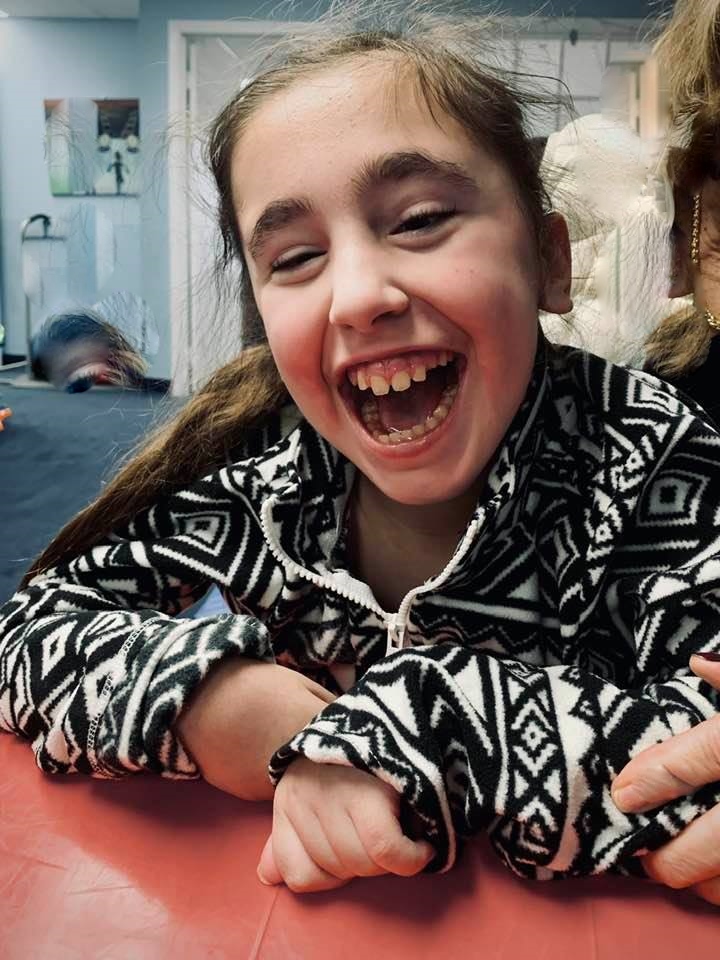
One of the issues I wrestle with since August 18 is whether I am still a mother. When your only child dies, are you a parent anymore? Max and I not only really, really enjoyed being Sarah’s parents, but because of her progressive and rare medical condition our whole lives basically revolved around her care. There were so many battles to be fought, both major and minor. Her education. Her specialists. Her medical treatment. Her diagnosis, which changed so many times. Her therapies. The shifting face of her disorder once she was diagnosed. We were constantly putting out fires and we were in a state of hypervigilance.
Our life now is easier in many ways and that’s painful to face. Both of us feel adrift to a large extent because of the vast amount of free time we have now compared to before August 18. We talk often about some kind of plan or project to fill the void, but at the same time we’re not ready. There have been discussions of volunteering with special needs kids, of service projects, of memorials for Sarah at her school and so forth. But we have failure to launch both daily and all around.
But back to my question. It causes me a lot of pain, this hypothetical motherhood issue. The probably more healthy, less-depressed part of me is exasperated by this, and responding “Of course you’re a mother.” I need to stop imagining panic-making scenarios in which nosy strangers demand to know how many children I have.
-
Of course, this is nothing compared to what you are going through
I hear this so much. It seems like every time I have a real moment of connectivity with someone or get to spend a little while talking about their issues for a few minutes, I get slammed back to inner space. In their minds, their problems are not relatable to la grande tragedie. I am other. They can’t possibly share my space. I am probably not even human anymore, devoid of empathy for a failed furnace or a bad boss or their own child’s problems.
This is so demoralizing. Yes, I have lost my child. Which is, several people have told me, the most stressful experience “on the list of stressful experiences.” (They are not correct, actually. The most stressful experience on the Social Readjustment Rating Scale is the death of a spouse, and divorce and incarceration also rate higher than the death of a close family member. So there’s that. But I guess their assumption speaks to the fears of parents everywhere.)
People used to do the same little dance around Sarah’s special needs, so maybe that’s why it’s triggering me. The “I could never do what you do” or “You are such an amazing mom” when you are doing nothing but putting a Cheerio in your child’s mouth. WTF?
I don’t really know what I want.
Yes, I have to say, nothing feels satisfying right now. There is no right way for other people to treat me. I’ve put other people in a totally impossible position. But maybe being pissed off is a lot easier than being sad all the time.
-
Encountering Death Outside Strosnider’s

Yesterday I drove up to Whole Foods and Strosnider’s on a little errand. I’m trying to make myself leave the house every day, which is often hard to do. I’ve needed some large nails for several weeks, so I went into Strosnider’s, and I thought I would check out the cakes at Whole Foods for my birthday as kind of a last hurrah, since I’ve decided after my birthday to start a low sugar kind of regime and general pullback from all that “kummerspeck” that we’ve been inhaling since August. Anyway.
So, outside Strosnider’s (which is a hardware store, by the way), I noticed this older woman, maybe in her sixties or seventies, dressed in a black ski coat and black pants who was pushing a black baby carriage the cover of which was zipped up tight. She was walking back and forth on the sidewalk among the shops in that strip. When I came out of Strosnider’s, she was still there, slow-walking. When I first saw her, I assumed she was airing a fussy baby, perhaps a grandchild. Then I saw her for the third time when I left Whole Foods and she was just mechanically walking around with this baby carriage. She wasn’t a beggar and she didn’t seem to be homeless.
As I was getting into my car it suddenly came to me that this woman was Death and that she was in the midst of carrying off this child. Which placed me in a kind of moral dilemma, it seemed. Should I try to stop her? Should I confront her? These thoughts flashed through my mind very quickly and I started crying a little bit in my car.
I did nothing. I drove home. I felt irrational and crazy.
When I got home I told Max about my encounter with “Death” outside Strosnider’s. He was reassuring that everyone has irrational thoughts and it’s not that big a deal unless you start acting on them. We joked that it’s much more likely that Death hangs out in Wheaton, probably at the Dunkin Donuts near the Metro Stop.
So, while there are truly psychotic people in the world, I am probably just a little farmisht. The important takeaway is that I did not run over this woman with my car. That is a success story to build on.
-
Subscribe
Subscribed
Have a WordPress.com account? Log in now.

